 how-to
Hot Tub Water Care Without a Mineral Cartridge
Last Updated: November 8, 2026
Quick Summary
Hot tub water care without a mineral cartridge means your sanitizer does all the work, so you must handle sanitizing, oxidizing, and circulating yourself. Test at least three times a week and aim for the middle of the sanitizer range: free chlorine 2 to 3 ppm or bromine 4 to 5 ppm.
- A mineral cartridge releases silver ions that suppress bacterial growth between soaks, a backup you lose without one.
- Test free chlorine or bromine daily and pH and total alkalinity every other day.
- Clean hot tub filters every two weeks and deep clean them monthly to keep circulation strong.
- Shock to 10 ppm, clean the filter, and retest when sanitizer demand keeps eating chlorine.
- Keep pH at 7.4 to 7.6, total alkalinity at 80 to 120 ppm, and calcium hardness at 150 to 250 ppm.
Table of Contents
- How Sanitizing Works When You Skip the Mineral Cartridge
- Hot Tub Chlorine vs. Bromine: Picking Your Primary Sanitizer
- Your Hot Tub Water Testing Schedule and Sanitizer Targets
- Balancing Hot Tub Water: pH, Alkalinity, and Hardness
- How to Clean Hot Tub Filters So Sanitizer Lasts Longer
- A Step-by-Step Weekly Routine for Tubs Without a Cartridge
- Troubleshooting Cloudy Water, Odor, and Foam Without a Cartridge
- Stock Your Hot Tub Chemical Kit at Allvalley
- Frequently Asked Questions
How Sanitizing Works When You Skip the Mineral Cartridge
Hot tub water care without a mineral cartridge comes down to one simple truth: hot tub water care is now entirely on you, because you are the entire sanitation system. A mineral cartridge sits in your plumbing and releases silver ions around the clock, quietly slowing bacterial growth between soaks.
Warm, aerated water full of organic waste breeds bacteria.
So what changes? Your sanitizer has to do all the work, all the time.
What a Mineral Cartridge Actually Does
A mineral cartridge is a small plumbed-in unit that releases silver ions into the water. Silver suppresses bacterial reproduction between soaks.
Pull the cartridge and you lose that backup. Your residual sanitizer now holds the line alone, meaning higher targets and more frequent testing.
The Three Jobs You Now Own
Without a cartridge, three jobs land on your plate:
- Sanitizing: Killing bacteria and viruses with chlorine or bromine
- Oxidizing: Burning off sweat, oils, and lotions that sanitizer can't destroy
- Circulating: Moving water through the filter so all of the above reaches every gallon
Miss any one and the water tells you fast, cloudy, smelly, or foamy water usually means a job slipped.
Hot Tub Chlorine vs. Bromine: Picking Your Primary Sanitizer
Chlorine and bromine are the two common primary sanitizers for hot tubs. Each has trade-offs in cost, speed of action, and performance in hot water.
Here's the honest breakdown:
| Factor | Chlorine | Bromine |
|---|---|---|
| Cost | Lower | Higher |
| Speed of action | Fast | Slower |
| Performance in hot water | Good | Better |
| Smell and feel | Sharper | Milder |
| Best for | Frequent use | Occasional use |
A common mistake is switching sanitizers mid-season without draining. Pick one and stick with it until your next water change.
For a deeper side-by-side on cost, feel, and maintenance, our hot tub bromine vs chlorine comparison guide walks through both options in detail.
Your Hot Tub Water Testing Schedule and Sanitizer Targets
Test your hot tub water at least three times a week, and daily during heavy use. Skipping tests is the most common cause of water problems in cartridge-free tubs.
Here's the routine we recommend:
- Daily: Check free chlorine or bromine with a test strip
- Every other day: Check pH and total alkalinity
- Weekly: Test hardness and shock the tub
Sanitizer targets: keep free chlorine between 1 and 3 ppm, or bromine between 3 and 5 ppm. Without a mineral cartridge, aim for the middle of those ranges rather than the low end.
Watch out: a reading of "0.5 ppm chlorine" is not close enough. That's a tub that's already losing the fight.
Why the Cartridge-Free Targets Sit Higher
A mineral cartridge releases silver ions that suppress bacterial reproduction between soaks, letting owners run lower residual sanitizer. Without it, your free chlorine or bromine residual is the only thing standing between bather waste and bacteria, so the middle of the range becomes your floor.
Holding a higher free chlorine residual gives a buffer that can survive a soak and a hot afternoon.
Reading a Test Strip Correctly
Test strips are fast but easy to misread. A few habits make them reliable:
- Dip the strip and swirl it for the full time on the label, usually 15 to 30 seconds, then read it immediately. Strips left sitting read falsely high.
- Read in daylight, not under a porch light. Color pads shift under warm lighting.
- Keep strips dry and capped. Humidity degrades them faster than the expiration date suggests.
A liquid test kit gives more precise free chlorine and pH readings than test strips. Many owners keep strips for daily checks and a drop kit for weekly confirmation.
When to Test More Often
Three times a week is the baseline for a lightly used tub. Increase testing when:
- Bather load spikes: Every additional bather adds sweat, oils, and lotion. Test before and after a group soak.
- Water temperature rises: A tub at 104°F burns through sanitizer faster than one at 100°F.
- The tub sits unused in summer: Warm, still water is where bacteria gain ground. Run the jets and test even on weeks you don't soak.
The Numbers to Write on the Inside of Your Cabinet Door
Keep these targets visible so every test has a reference point:
- Free chlorine: 1 to 3 ppm (aim for 2 to 3 ppm without a cartridge)
- Bromine: 3 to 5 ppm (aim for 4 to 5 ppm without a cartridge)
- pH: 7.4 to 7.6
If free chlorine reads zero two days in a row despite dosing, you have a demand problem, not a dosing problem. Shock, clean the filter, and retest before adding more sanitizer.
Balancing Hot Tub Water: pH, Alkalinity, and Hardness
Balancing hot tub water means keeping three numbers in range: pH, total alkalinity, and calcium hardness. Get these right and your sanitizer works properly. Get them wrong and you'll burn through chemicals chasing problems.
The targets:
- pH: 7.4 to 7.6
- Total alkalinity: 80 to 120 ppm
- Calcium hardness: 150 to 250 ppm
Adjust alkalinity first, then pH. Alkalinity is the buffer that holds pH steady, so fixing pH on unstable alkalinity is wasted effort.
For a full walkthrough of dosing and order of operations, our complete guide to balancing hot tub pH levels covers each step.
How to Clean Hot Tub Filters So Sanitizer Lasts Longer
Clean your hot tub filters every two weeks, and deep clean them monthly. A clogged filter starves your sanitizer of circulation, and no amount of chemical fixes that.
Here's the process:
- Power off the tub and pull the cartridges
- Rinse each one with a garden hose, top to bottom
- Soak in a filter cleaning solution for the time on the label
- Rinse again until the water runs clear
- Reinstall and run the jets for a few minutes
A common mistake is blasting the pleats with a pressure washer. That shreds the fabric and destroys filtration.
Keep two sets of filters and swap them during cleaning. It cuts your downtime to minutes. For detailed steps, see our step-by-step hot tub filter cleaning guide.
A Step-by-Step Weekly Routine for Tubs Without a Cartridge
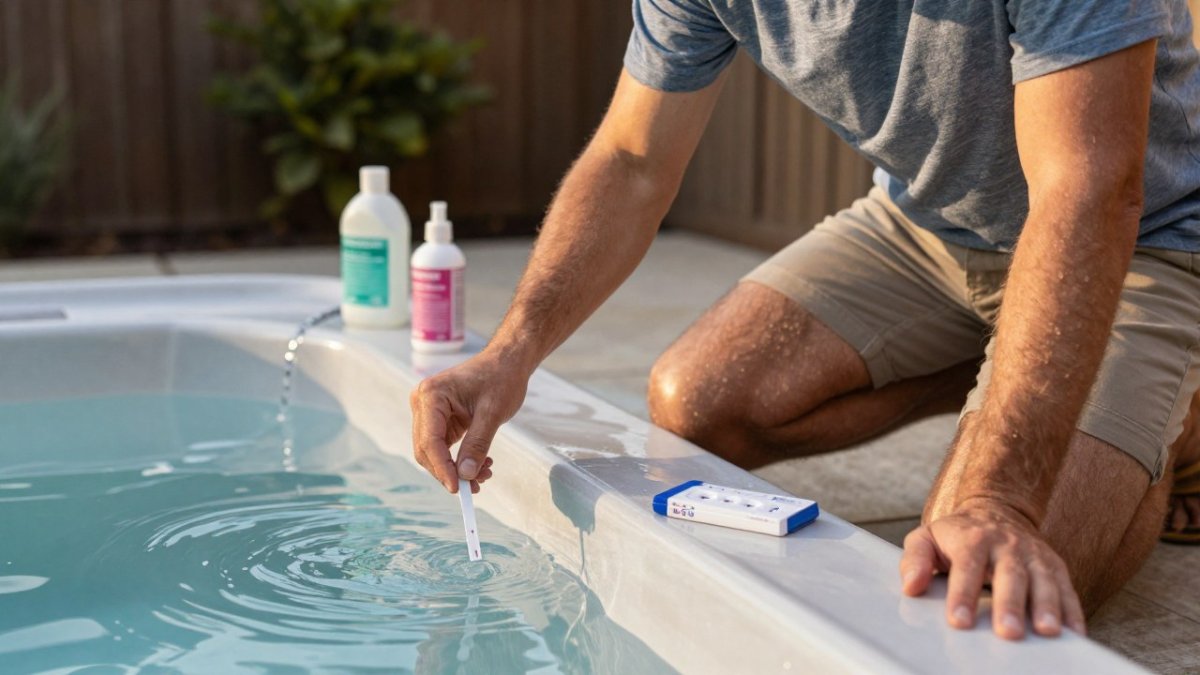
Run this routine and cartridge-free water care stops being a guessing game. It takes about fifteen minutes a week, plus a quick daily strip check.
Daily, Weekly, and Monthly Tasks
- Daily: Test sanitizer and run the jets for 15 minutes
- Weekly: Test pH and alkalinity, shock the tub, clean the waterline
- Monthly: Deep clean filters, check hardness, inspect the cover
Adjusting for Bather Load, Temperature, and Tub Size
Three factors change your numbers:
- Bather load: Each person adds sweat and oils. After a group soak, shock the tub and expect to top up sanitizer.
- Temperature: Hotter water burns through sanitizer faster. A tub held at 104°F needs more attention than one at 100°F.
- Tub size: A small tub concentrates contaminants quickly. Larger tubs dilute them but take more chemical to treat.
Troubleshooting Cloudy Water, Odor, and Foam Without a Cartridge
Cloudy water almost always means one of two things: low sanitizer or a dirty filter. Check both before you add anything to the tub.
Here's a quick diagnostic:
| Problem | Likely Cause | Fix |
|---|---|---|
| Cloudy water | Low sanitizer or clogged filter | Shock and clean filters |
| Strong chemical smell | Built-up chloramines | Shock and run jets |
| Foam | Soap residue or high organics | Rinse suits, shock, use defoamer |
| Green tint | Metals or algae | Test and treat metals |
For a focused list of causes and fixes, our guide on why hot tub water turns cloudy breaks down seven common culprits.
Watch out: adding clarifier to hide cloudiness without fixing the cause just pushes the problem into your filter.
Why Cartridge-Free Tubs Fail Differently
A mineral cartridge masks small problems. Silver ions slow bacterial growth, so a tub with a cartridge can look clear for a day or two after a sanitizer dip.
Most cartridge-free water problems trace back to one of three failures: sanitizer dropped to zero, circulation stalled, or organics built up faster than you oxidized them. Diagnose which before you reach for a bottle.
Cloudy Water: A Step-by-Step Response
- Test free chlorine or bromine first. If it's at or near zero, the cloudiness is a sanitation failure. Shock the tub, run the jets, and retest the next morning.
- Check the filter. Pull the cartridge and inspect it. A filter matted with oils and lotion can't pass water, and no amount of chemical clears water the filter can't polish.
- Look at the waterline. A greasy ring at the waterline means oils are building up. Wipe it down with a dedicated waterline cleaner before it feeds the cloudiness.
- Give it 24 hours. If the water hasn't cleared after a shock and a clean filter, the problem is organic load, not a one-time event. Shock again and plan a drain and refill if the water is more than three months old.
Strong Chemical Smell: Chloramines, Not Chlorine
The sharp "pool smell" people blame on chlorine is usually chloramines, combined chlorine formed when chlorine reacts with sweat, urine, and oils.
Shock the tub to break the chloramine bond, run the jets with the cover open for 30 minutes to let the gas off, and retest.
Bromine tubs can develop a similar stale smell from bromamines. The response is the same: shock and ventilate.
Foam: Find the Source Before You Defoam
Foam is a symptom, not a cause. Defoamer knocks it down for a day, but if you don't remove the source it comes back. The usual sources:
- Detergent residue on swimsuits. Rinse suits in plain water, not detergent, and never use fabric softener.
- Lotions, sunscreen, and body oils. Shower before soaking, and shock after heavy-lotion soaks.
- High total dissolved solids. Old water holds dissolved organics that foam at the surface. If the water is near its change interval, drain and refill.
Once the source is removed, a single defoamer dose clears the surface. If foam returns within a week, you haven't found the source yet.
Green Tint: Metals or Algae
A green tint in a hot tub is usually dissolved copper or iron from source water, not algae, hot tub water is too warm and too sanitized for algae to thrive. Test for metals with a dedicated strip. If present, use a metal sequestrant and consider a pre-filter on your fill hose. If the tint appears alongside slippery surfaces and zero chlorine, treat it as a sanitation failure first: shock, clean the filter, and retest.
Sanitizer That Won't Hold
If you dose to target and free chlorine reads zero again within hours, you have sanitizer demand, organics are consuming chlorine faster than you can add it. Don't keep pouring in sanitizer. Shock to 10 ppm, clean the filter, run the jets, and retest. If demand persists after two shocks, drain and refill; old water with high dissolved solids will keep eating sanitizer no matter how much you add.
Stock Your Hot Tub Chemical Kit at Allvalley
A cartridge-free tub needs a slightly fuller chemical shelf than a mineral-assisted one. Here's what to keep on hand:
- Sanitizer: chlorine granules or bromine tablets
- Non-chlorine shock, such as MPS
- pH increaser and decreaser
Buying a kit beats piecing it together. Our hot tub chemical starter kit guide shows you exactly what belongs in one.
Our hot tubs come with a free starter kit and chemicals, so you're not scrambling for supplies on day one.
Running a hot tub without a mineral cartridge takes a little more attention, but it's entirely manageable with a steady routine.
Frequently Asked Questions
What can you use instead of a mineral cartridge in a hot tub?
You replace the cartridge's slow-release silver ions with a consistent primary sanitizer, either chlorine or bromine, plus regular shock treatment. A non-chlorine oxidizer such as MPS handles organic waste between doses. Ozone or a salt water system can supplement the routine, but neither replaces a sanitizer on its own. The key is testing often enough to keep sanitizer levels in range, since nothing is releasing a steady dose for you.
How often should you test hot tub water without a mineral cartridge?
Test sanitizer and pH daily with strips or a digital tester, ideally before each soak. Run a fuller check of total alkalinity and hardness once a week. Without a cartridge feeding silver ions, sanitizer levels drop faster, so daily readings catch problems before cloudy water or odor appears. Log your results for a week to learn how your tub behaves with its typical bather load.
Is chlorine or bromine better for a hot tub without a mineral system?
Chlorine is cheaper and dissolves fast, which suits tubs used a few times a week. Bromine holds up better in hot water and stays active across a wider pH range, which helps heavily used spas. Bromine costs more and has a distinct smell some people notice. Either works without a cartridge; pick one, learn its target range, and stay consistent rather than switching back and forth.
How do you keep hot tub water clear without a mineral cartridge?
Rely on three habits: keep free sanitizer in range, shock weekly with a non-chlorine oxidizer, and clean filters every one to two weeks. Rinse cartridge filters with a hose, then soak them in filter cleaner monthly. Run the jets and circulate water daily. If water turns cloudy despite good chemistry, check filtration and bather load before adding more chemicals, since overloaded filters are a common culprit.