 how-to
Does an Outdoor Fireplace Increase Home Value?
Last Updated: November 11, 2026
Quick Summary
An outdoor fireplace can make a home easier to sell, but it rarely adds a guaranteed dollar amount to the sale price. Buyers and appraisers focus on comparable sales, square footage, condition, and whether the outdoor space is usable. Its value depends heavily on your climate and local market.
- Buyers and appraisers focus on comparable sales, square footage, and condition
- Much of the value shows up in faster sales and better listing photos
- Usable outdoor space is the bigger factor than the fireplace alone
- Compare recent local sales of homes with and without the feature
- Check permit rules and talk to your insurer before building
Table of Contents
- What Buyers and Appraisers Actually Pay For
- How an Outdoor Fireplace Changes Curb Appeal and Usable Space
- Outdoor Fireplace Cost: What Drives the Price
- Outdoor Fireplace Return on Investment: A Worked Calculation
- Outdoor Fireplace Resale Value by Climate and Local Market
- Permits, Codes, Insurance and Safety Before You Build
- Deciding Whether to Build: Your Next Step with allvalley
- Frequently Asked Questions
What Buyers and Appraisers Actually Pay For
An outdoor fireplace can make a home easier to sell, but it rarely adds a guaranteed dollar amount to the sale price. Buyers and appraisers focus on comparable sales, square footage, condition, and whether the outdoor space is usable.
Think of it as a marketability upgrade. It gives buyers a reason to picture themselves hosting dinners outside. Much of the value often shows up in how quickly a home sells and how it photographs, rather than as a fixed line item on an appraisal.
Appraisers generally value a home by comparing it to recently sold homes nearby. If comparable homes in your area have outdoor fireplaces, yours may be treated as a matching feature. If they don't, the fireplace may count for little on paper, even though it still helps the listing.
- Buyers respond to finished, usable outdoor areas
- Appraisers rely on sales of similar homes
- Quality construction and clean finishes matter most
- Local demand decides how much the feature is worth
How an Outdoor Fireplace Changes Curb Appeal and Usable Space
A well-built outdoor fireplace gives the backyard a clear focal point. It turns an empty patio into a gathering area that people can use for much of the year.
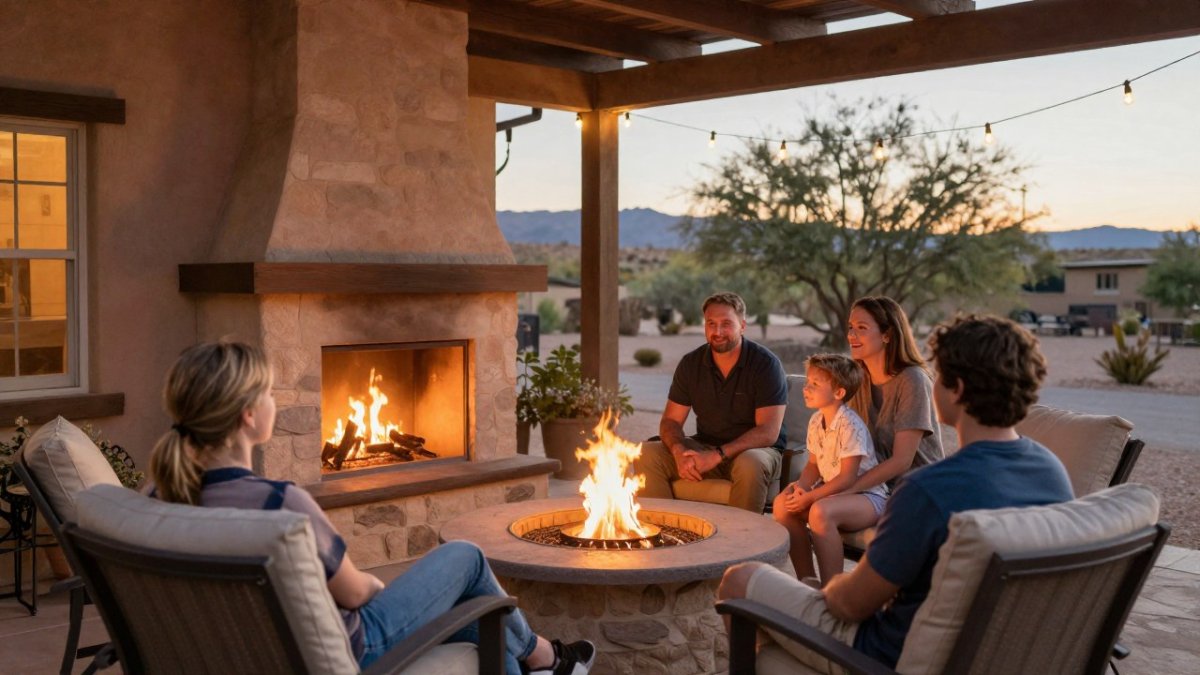
!A family relaxing around a lit outdoor fireplace on a covered patio at dusk in a desert backyard, with string lights and patio furniture
Curb appeal also matters. Listing photos that show a glowing fireplace and a set table can help a home stand out.
Usable space is the bigger factor. A patio with seating, a fireplace, and shade can work as a living room outdoors. Buyers who entertain may see that as a benefit.
Outdoor Fireplace Cost: What Drives the Price
Costs vary widely. Pricing depends on quantity, dates, and delivery, as well as the design, materials, size, the amount of site work, and whether you need gas lines. For current prices or a quote on your project, contact allvalley directly at 760-342-5277.
Several factors push the cost up or down:
- Fuel type: Wood-burning and gas models can differ in cost
- Materials: Stone, brick, and metal finishes vary in price
- Site work: Concrete pads, drainage, and access can add expense
- Installation: Professional installation is a separate line item
Fire Pit Versus Outdoor Fireplace: Cost and Resale Comparison
A fire pit usually costs less to install and is easier to move or remove. An outdoor fireplace is a more permanent build, which means higher upfront cost but a stronger impression of a finished space. Buyers may see the fireplace as part of the home, while a fire pit may be viewed as furniture.
If resale is the goal, the fireplace is more likely to read as a built-in feature. For a deeper look at the trade-offs, see Wood-Burning Fire Pits: Pros and Cons.
The main cost drivers are summarised below.
| Cost driver | What it affects | Note |
|---|---|---|
| Fuel type | Price | Wood-burning and gas models can differ |
| Materials | Price | Stone, brick, and metal finishes vary |
| Site work | Expense | Concrete pads, drainage, and access add cost |
| Installation | Separate line item | Professional installation is billed separately |
Outdoor Fireplace Return on Investment: A Worked Calculation
Return on investment for an outdoor fireplace is not a universal percentage, and any source that quotes one is guessing. What you can do is build a defensible estimate using your own numbers and local comparable sales. A practical approach is to compare what you spend with what similar homes actually sell for.
Step 1: Establish your all-in cost
Start with the full cost of ownership, not just the build. A realistic first-year cost includes:
- Design and permits
- Materials and labor for the fireplace and any masonry, hearth, or chimney
- Gas line or fuel connection, if applicable
- Site work such as a pad, drainage, or electrical
- Landscaping or hardscape repair after installation
- The first year of fuel, cleaning, and any service contract
Site work and fuel connections are line items homeowners often underestimate. Get a written quote that separates each of these so you can compare bids fairly.
Step 2: Find your comparable sales
Ask a local real estate agent to pull recent sales of homes in your neighborhood that are similar in square footage, lot size, age, and condition. Then split them into two groups: homes with a built-in outdoor fireplace or comparable outdoor living feature, and homes without one. The price difference between those groups, adjusted for other differences, can give you a local estimate of what the feature contributes.
The feature may matter more in neighborhoods where outdoor living is already common and buyers expect it. In neighborhoods where few homes have one, it may help a home sell faster without necessarily moving the price much.
Step 3: Run the net calculation
Subtract your all-in cost from the estimated sale price difference. If the result is negative, the fireplace is a lifestyle purchase rather than a financial one, which is a legitimate reason to build as long as you go in with clear eyes. If the result is positive or close to zero, the feature is likely to pay for itself in marketability and speed of sale.
Step 4: Account for time and upkeep
ROI is not only the sale price. Factor in how many years you will use the fireplace before selling, the annual cost of fuel and cleaning, and any repairs. A fireplace you enjoy for a decade before selling has a different return than one installed the year you list.
Keep in mind that a neighbor's sale price is not proof of your own gain. The comparable must match your home on the major variables, or the difference you calculate will be noise rather than signal.
Outdoor Fireplace Resale Value by Climate and Local Market
Climate and local market conditions decide whether an outdoor fireplace reads as a valuable feature or a novelty. The table below is a decision framework, not a guarantee. Use it as a starting point to judge whether the feature fits your property.
Climate: how much use will buyers imagine?
- Mild evenings for most of the year: Buyers can picture using the fireplace across seasons, so it tends to strengthen marketability. This is the climate where the feature is most likely to be treated as usable living space.
- Hot summers and mild winters: The fireplace is a cool-weather amenity. It still helps in the evening and winter months, but buyers may weigh shade, misting systems, or a pool more heavily.
- Cold winters with heavy snow: The fireplace is seasonal and may be buried for months. Buyers in these markets may value a heated or enclosed space more than an open hearth.
- Coastal or windy areas: Wind, salt air, and corrosion affect materials and maintenance. Buyers who know the area may ask about material durability and wind screening.
Local market: is the feature expected or special?
In neighborhoods where most homes already have outdoor entertaining areas, a fireplace may be expected rather than a differentiator. In markets where few homes have one, it can stand out in listing photos and showings. The way to know which situation you are in is to look at recent listings and sales in your immediate area, not the metro average.
Property type: where the feature fits best
- Single-family homes with usable yards: The strongest fit, especially where the patio or deck is already finished.
- Homes at the top of the local price range: Buyers at this tier may expect outdoor living features, so a well-built fireplace may help a home compete.
- Entry-level or small-lot homes: The cost may be hard to recover, and a fire pit or portable feature may deliver more of the lifestyle benefit for less.
- Homes with limited outdoor space: A fireplace can crowd a small patio. Buyers may see it as an obstacle rather than an amenity.
The buyer profile test
Ask your agent who is most likely to buy your home. If the likely buyer is a family that entertains, a fireplace can reinforce the home's story. If the likely buyer is downsizing or focused on low maintenance, the upkeep and permanence may count against it. The feature helps most when it matches the buyer the home already attracts.
Watch out: a fireplace that blocks a view, crowds a walkway, or sits too close to a property line can hurt rather than help. Check clearances and sight lines before you commit to a location.
Permits, Codes, Insurance and Safety Before You Build
Before you build, check with your city or county about permit requirements. Many jurisdictions require permits for permanent outdoor fireplaces, and rules on setbacks, clearances from structures, and gas connections vary by location. A permit record also helps when you sell, since buyers and inspectors may ask about unpermitted work.
Talk to your insurance company before you build. Some policies treat outdoor fire features differently, and a claim can be complicated if the work was not permitted. Follow local codes for clearances and ventilation. For guidance on installing outdoor fire features safely, review the full checklist before work begins.
- Check local permit rules before any digging begins
- Confirm clearances from fences, walls, and overhangs
- Ask your insurer how the feature is covered
- Keep permit records and receipts for future buyers
Deciding Whether to Build: Your Next Step with allvalley
An outdoor fireplace is most likely to help your home sell if it fits your yard, your climate, and your neighborhood. Start by comparing recent local sales, getting a clear cost estimate, and checking permit rules.
If you're ready to explore options, allvalley has served Coachella Valley and Riverside County homeowners for over 26 years, with professional delivery and installation services. Call us at 760-342-5277 for current pricing and a quote for your backyard. If you already own a fireplace, you can learn when professional repair is needed.
Frequently Asked Questions
Does an outdoor fireplace increase home value?
It can, but rarely by a guaranteed dollar amount. An outdoor fireplace is most likely to help when it is well built, well maintained and fits the home and yard. Buyers in many markets value outdoor living space, especially where evening entertaining is common. Appraisers generally look at comparable homes and whether the feature is permitted and functional, so the effect on a sale price depends on local demand and the specific property. Treat it as a way to improve marketability and buyer appeal rather than a reliable return.
What type of fireplace adds the most value?
Features that are permanent, permitted and built from quality materials tend to be the most persuasive to buyers. A masonry or well-finished gas outdoor fireplace integrated into the patio or pool area usually reads as a planned improvement, while a portable unit or an unfinished DIY structure adds little. Gas models can offer convenience and easier maintenance than wood-burning designs. The best choice depends on your local market and the look of your home, so compare what similar homes nearby offer.
Is an outdoor fireplace worth it if I plan to sell soon?
It can be, if you account for the full cost and do not expect the feature to recover all of its price at sale. Build cost, permits and installation may exceed what a homeowner recoups at sale, so the decision can work best when the fireplace also improves your daily use. If you plan to sell within a year or two, consider a lower-cost option such as a fire pit, or make sure the feature is clearly finished and documented for buyers. Pricing depends on design, materials and site conditions, so request a quote from allvalley at your home.
Does a fireplace make your house insurance go up?
It can. Insurers may review fire features, especially wood-burning units or structures near the home, and some policies require notice of new installations. Gas units with professional installation may be viewed differently than unpermitted DIY builds. Ask your insurance agent before you build, and keep permits and installation records to show the feature was built to code.