 listicle
Is Hiring a Landscape Architect Worth It for Your Backyard?
Last Updated: October 31, 2026
Quick Summary
Hiring a landscape architect is worth it for a backyard that involves structures, grading, drainage or a significant budget. A licensed landscape architect plans the whole space, from site analysis and drainage to permits and contractor coordination, which helps avoid costly rework later.
- A licensed landscape architect can stamp plans that permitting offices often require.
- Site analysis covers soil, slope, water runoff and underground utility locations before design begins.
- Most residential fees are charged hourly, as a flat fee per phase, or as a percentage of construction cost.
- Ask each firm for a written proposal that separates design, permits and construction oversight.
- For simple planting refreshes, a landscape designer or a well-planned DIY approach may be enough.
Table of Contents
- What a Landscape Architect Actually Does for a Backyard
- Landscape Architect vs. Landscape Designer: Which One Fits Your Project?
- Site Analysis, Drainage, and Grading: The Technical Work Homeowners Miss
- Backyard Before-and-After Examples and Where the Value Shows Up
- How Much a Landscape Architect Costs Per Hour and What Drives the Total
- Questions to Ask a Landscape Architect Before You Sign
- Backyard Landscaping Mistakes to Avoid When You Plan Your Space
- Booking Your Backyard Consultation and Next Steps
- Frequently Asked Questions
A backyard is one of the most expensive rooms a homeowner will ever build, and most people build it without a plan. In the Coachella Valley, where summer temperatures routinely climb past 110 degrees, the way a yard is laid out determines whether it becomes a usable retreat or a hot, underused patch of concrete. This guide from allvalley looks at whether hiring a landscape architect is worth the cost for a residential backyard.
A landscape architect is a licensed professional who plans outdoor spaces as a whole, from grading and drainage to planting, hardscape and how people will move through the yard. See how one is planned as a whole space in How to Design a Luxury Backyard Retreat. The benefit for most homeowners is avoiding expensive rework.
What a Landscape Architect Actually Does for a Backyard
A landscape architect starts by studying the site before drawing anything. That means measuring the lot, mapping slopes, noting where sun and shade fall across the day, and identifying existing trees, utility lines and water flow. Professional expertise shows up in these early steps, which often reveal constraints a homeowner would not spot until construction.
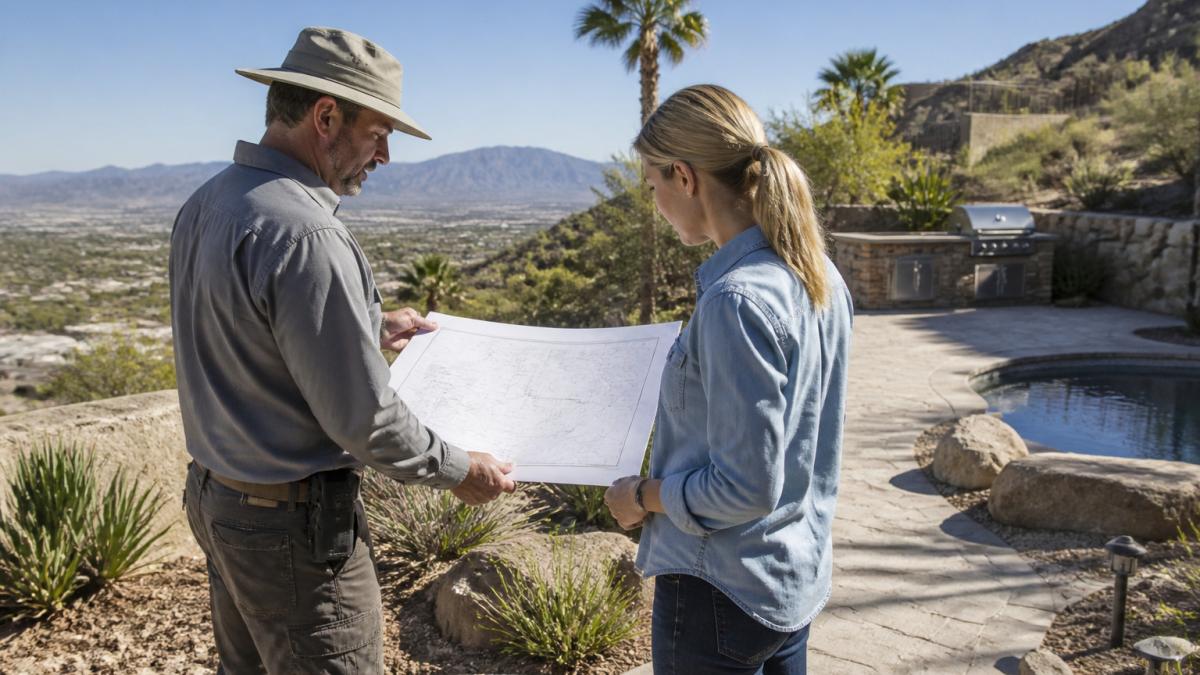
From there, the work moves into long-term planning. The designer sets a concept for how the yard will function, whether for entertaining, a pool area, a family play zone or a quiet garden. Space planning ties the pieces together so the spa, outdoor kitchen, fire feature and planting beds sit in a logical order.
The final stage is project oversight. Many landscape architects prepare construction documents, coordinate with contractors, and check the built work against the plan. Homeowners often struggle when no one owns that coordination step, so ask any designer you consider who handles it.
Landscape Architect vs. Landscape Designer: Which One Fits Your Project?
The titles overlap, and that confuses many buyers. A landscape architect typically holds a degree in landscape architecture and a state license, which allows them to stamp drawings for permitting in many jurisdictions. A landscape designer may have formal training or strong experience but often does not hold that license.
Pros of a landscape architect:
- Licensed and able to stamp plans that permitting offices require
- Strong on grading, drainage and structural coordination
- Well suited to full backyard renovations with multiple structures
Cons of a landscape architect:
- Usually costs more per hour than a designer
- Can be overkill for a simple planting refresh
Pros of a landscape designer:
- Often lower cost for planting and aesthetic-focused work
- Can be a good fit for small, straightforward yards
Cons of a landscape designer:
- May need a separate engineer or architect for permitted structures
- Licensing rules vary, so confirm credentials before hiring
For a project involving a pool, a spa pad, retaining walls or a covered kitchen, a licensed landscape architect is usually the safer choice.
Site Analysis, Drainage, and Grading: The Technical Work Homeowners Miss
Most homeowners focus on the look of a backyard and skip the technical base. Site analysis covers soil type, slope direction, water runoff and the location of underground utilities. Each of these affects what can be built and where.
Drainage deserves special attention. Water that pools against a house foundation or flows toward a neighboring lot can create legal and structural problems. Proper grading directs runoff away from structures, and a landscape architect will plan that before the patio goes in.
Permits add another layer. Depending on the city or county, structures such as covered patios, fences, retaining walls and fire features may require approval. Local building departments set those rules, so check with yours before finalizing a design.
Backyard Before-and-After Examples and Where the Value Shows Up
Abstract benefits are easy to list and hard to believe. What convinces homeowners is seeing how a specific problem in a specific yard was diagnosed and solved. The patterns below are the ones that come up again and again in residential backyard work, use them as a checklist for what to look for in any portfolio a firm shows you.
How to evaluate a firm's before-and-after work
- Ask for projects in your climate and lot type, not generic renderings.
- Ask what problem the design solved, not just what it looks like.
- Ask what the project cost and what drove that cost.
- Ask whether the homeowner would make the same choices again.
How Much a Landscape Architect Costs Per Hour and What Drives the Total
Cost is the question most homeowners ask first, and it is the one most design articles dodge.
How design fees are usually structured
Most residential landscape architects use one of three models:
- Hourly. Common for consultations, site visits and small scopes. You pay for time, and the total depends on how many revisions and meetings the project requires.
- Flat fee per phase. The designer quotes a set price for schematic design, a separate price for construction documents, and a separate price for construction oversight. This is the easiest model to budget against because each phase has a defined deliverable.
- Percentage of construction cost. Some firms charge a design fee equal to a percentage of the projected build cost, which ties their compensation to project complexity. Ask whether the percentage is calculated on the estimate or the final contract amount.
What drives the total up or down
- Lot size and complexity. A flat quarter-acre lot with simple grading costs far less to plan than a sloped lot with retaining walls, drainage swales and utility conflicts.
- Structures and permits. Pools, spas, covered patios, fire features and retaining walls above a certain height trigger engineering, permit drawings and inspections. Each adds documentation time.
- Number of revisions. Most firms include a set number of revision rounds. Additional rounds are billed hourly, so arriving with clear priorities is the single biggest lever you control.
- Construction oversight. Site visits during construction are often billed separately from design. Confirm whether oversight is included or added.
Where the money actually goes
Design fees are typically a small fraction of the total project budget, the construction itself (hardscape, pool, planting, irrigation, lighting) is where most of the money lands. This level of oversight remains equally critical when navigating the complexities of hiring contractors versus subcontractors to ensure that the execution of your plan matches the precision of the initial design.
Return on investment, realistically
Landscape improvements can support resale value, but no responsible professional will promise a specific return. What a well-planned backyard reliably delivers is use value: more evenings outside, a space that functions for entertaining, and lower ongoing water and maintenance costs when the planting and irrigation are designed together.
Because rates differ widely by market and firm, we do not publish a single number here. Instead, ask each firm for its fee structure, what is included at each phase, and what triggers an added charge, then compare proposals side by side.
Fee structures and cost drivers vary by firm, but the main factors are easy to compare side by side.
| Fee model | How it works | Best for |
|---|---|---|
| Hourly | Pay for time spent on meetings and revisions | Consultations and small scopes |
| Flat fee per phase | Set price for each deliverable | Easiest budgeting |
| Percentage of construction cost | Fee tied to projected build cost | Complex projects |
| Lot complexity | Sloped lots and retaining walls add time | Affects total design effort |
| Structures and permits | Pools, spas and walls add documentation | Adds engineering and inspections |
| Revision rounds | Extra rounds billed hourly | Clear priorities keep costs down |
| Construction oversight | Site visits may be billed separately | Confirm inclusion before signing |
Questions to Ask a Landscape Architect Before You Sign
Before committing, ask a few direct questions:
- Are you licensed, and can you stamp drawings for permits?
- Who manages contractor coordination during construction?
- Can you show completed backyard projects in the Coachella Valley?
- How many design revisions are included in your fee?
- What does your estimate cover, and what would trigger an added charge?
- Do you carry professional liability insurance?
Clear answers to these questions reduce surprises. Vague answers are a warning sign.
Backyard Landscaping Mistakes to Avoid When You Plan Your Space
The most common mistake is designing the look before the function. A stunning fire pit placed where wind blows smoke into the seating area will get little use. Start with how you plan to use the yard, then design around that. If cost is your concern, Budget-friendly patio ideas can help you upgrade before committing to a full plan.
Another frequent error is underestimating water and shade. Desert yards need careful planning for irrigation zones and shade structures, and both affect comfort through the summer months.
Finally, many homeowners skip maintenance planning. Choose plants and materials you can realistically care for. A yard that looks good on day one but demands constant upkeep will disappoint. Browse Best Low Maintenance Plants for Backyard Gardens to avoid high-maintenance choices that cause problems later.
Booking Your Backyard Consultation and Next Steps
Hiring a landscape architect is worth it when a backyard project involves structures, grading, drainage or a significant budget. For simple refreshes, a designer or a well-planned DIY approach may be enough. Whatever you choose, start with a site visit and a clear list of how you want to use the space.
Ready to plan your backyard retreat? Call allvalley at 760-342-5277 to talk through your project. We offer product selection, delivery and installation services, and can point you toward the right next step for your yard.
Frequently Asked Questions
What does a landscape architect actually do?
A landscape architect plans how an outdoor space will function and look over time. For a backyard, that usually means surveying the site, checking slope, drainage and sun exposure, then producing a layout with hardscape, planting and utility locations. Many also prepare construction drawings, specify materials, and coordinate contractors during installation. The work is less about choosing plants and more about making sure the design can be built correctly and will still work after the first few years.
What is the difference between a landscape architect and a landscape designer?
Landscape architects typically hold a license and a degree in landscape architecture, and they are qualified to handle grading, drainage plans and permit-ready drawings. Landscape designers focus mainly on the visual layout and planting concept and may not hold a license. For a simple planting refresh a designer may be enough. For a full backyard renovation involving slopes, retaining walls or drainage, a licensed landscape architect is usually the safer choice.
How much does a landscape architect charge per hour?
Hourly rates vary by firm, project complexity and region, and allvalley has not published landscape architect rates. Ask each firm for a written estimate that breaks out site visits, concept design, construction drawings and construction administration. Requesting a fixed-fee proposal for defined phases can make the total easier to compare. For current pricing on allvalley's own products and services, contact the team directly for a quote.
Can a landscape architect help with drainage and grading?
Yes. Drainage and grading are core parts of landscape architecture, especially on sloped Coachella Valley lots where water can pool against patios or foundations. A landscape architect can survey existing elevations, design swales or drains, and specify grades that direct runoff away from structures. Coordinate with your local building department on any permits required for grading or retaining walls before construction begins.