 listicle
Signs Your Outdoor Fireplace Needs Professional Repair
Table of Contents
- Why Outdoor Fireplaces Need Professional Repair
- 8 Warning Signs Your Outdoor Fireplace Needs Professional Repair
- What an Outdoor Fireplace Inspection Covers
- Cracked Outdoor Fireplace Masonry: When It's a DIY Fix vs. a Pro Job
- Outdoor Fireplace Smoke Problems: Causes and Fixes
- Outdoor Gas Fireplace Troubleshooting: Safe Checks Before You Call
- Repair or Replace? How to Decide
- Prevention and Maintenance Schedule for Outdoor Fireplaces
- Frequently Asked Questions
Last Updated: October 19, 2026
Why Outdoor Fireplaces Need Professional Repair
An outdoor fireplace takes a beating an indoor one never sees: sun, monsoon rain, desert wind, and constant heating and cooling cycles work on masonry and metal year-round.
Wind-blown sand grinds at mortar joints, UV dries out sealants, and a single hard rain pushes water into places it never dries out, slow damage that stays invisible until it isn't.
That's the real problem: outdoor fireplace repair is almost always reactive because the damage hides in plain sight.
8 Warning Signs Your Outdoor Fireplace Needs Professional Repair
Here are the eight warning signs your outdoor fireplace needs professional repair, ranked roughly by urgency. Some are cosmetic until they aren't. Others mean stop lighting fires today.
- Smoke backing up or poor ventilation
- Weak draft or loss of updraft
- Cracks in the firebox, masonry, or chimney
- Damaged chimney structure or crown
- Unusual, sour, musty, or smoky odors
- Soot or creosote buildup
- Rust or corrosion on metal components
- Water intrusion, staining, or other moisture damage
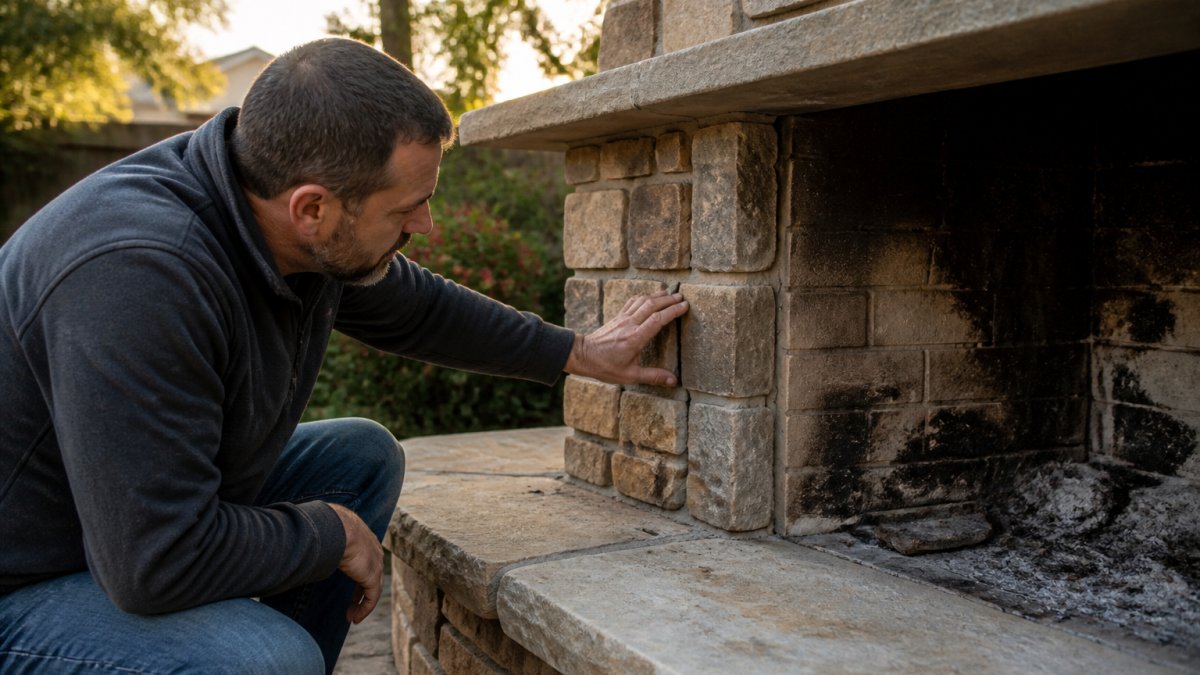
Smoke Backing Up or Poor Ventilation
Smoke that rolls into your face instead of up the flue usually points to a blocked flue, a chimney too short for the surrounding structure, or an altered firebox. If it backs up only on gusty days, chimney height or cap is the likely culprit; if it happens every time, stop burning until someone inspects the flue.
Weak Draft or Loss of Updraft
A fireplace that used to draw well and now struggles has lost its updraft, from a nest or debris blockage to a separated or collapsed flue liner. Cooler temperatures and a cold flue can cause temporary weak draft, which is normal. Persistent weak draft is not, it's a ventilation problem that worsens with use.
Cracks in the Firebox, Masonry, or Chimney
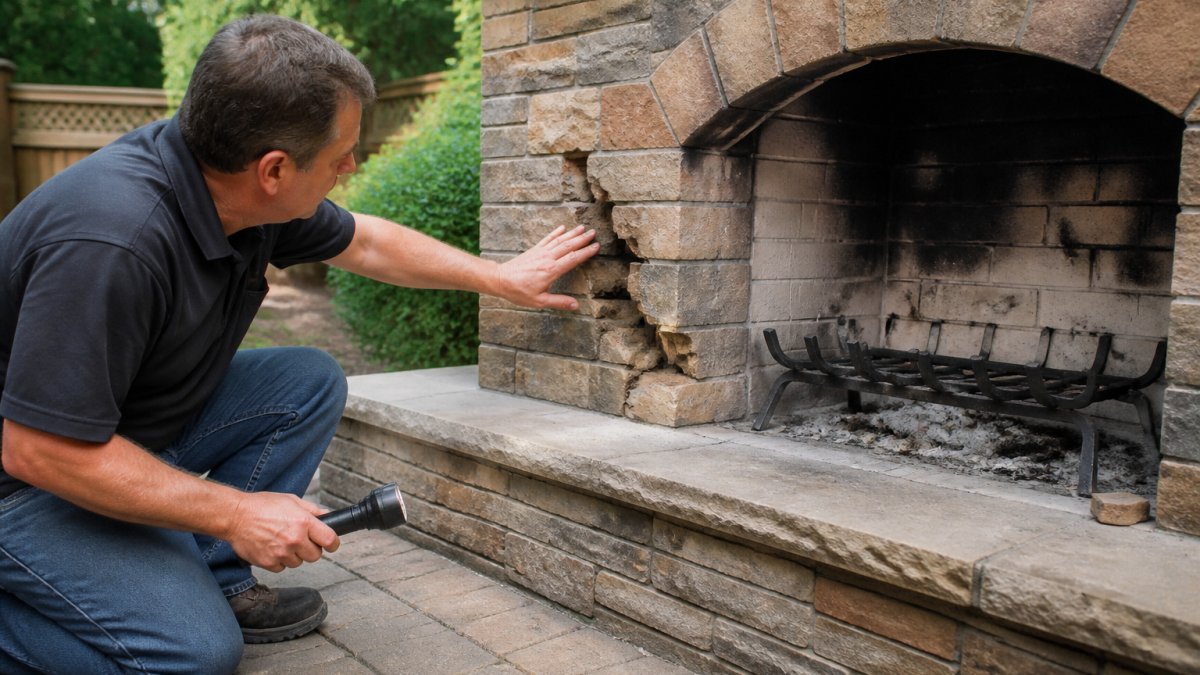
Cracked outdoor fireplace masonry is the sign most homeowners underestimate. Hairline veneer cracks are often cosmetic; firebox cracks are a different category, letting heat and embers reach materials never meant to take them. Run a hand over the cold firebox interior, if you feel a lip or edge where a crack has opened, get it looked at before the next fire.
Damaged Chimney Structure or Crown
The chimney crown is the concrete cap that sheds water away from the masonry below. When it cracks or crumbles, water goes straight into the chimney structure; a leaning chimney, loose bricks near the top, or visible crown gaps all point to structural damage. Crown damage is a cheap fix early and a rebuild later.
Unusual, Sour, Musty, or Smoky Odors
A musty or sour odor usually means moisture is trapped in the masonry. A smoky smell with no fire burning often points to creosote buildup or a draft problem pulling air back down the flue. If the smell shows up after rain, suspect water intrusion; if it's constant, suspect creosote.
Soot or Creosote Buildup
Some soot is normal; heavy, flaky, or glazed creosote is not. Creosote restricts the flue, worsens draft, and is the leading contributor to chimney fires in wood-burning units. Visible creosote at the top of the firebox or around the damper means the flue needs cleaning and inspection.
Rust or Corrosion on Metal Components
Rust on the damper, spark screen, grate, or firebox panels is common outdoors but shouldn't be ignored. Surface rust is cosmetic; corrosion eaten into hinges, the damper mechanism, or gas burner components affects operation and can make parts seize.
Water Intrusion, Staining, or Other Moisture Damage
White staining on masonry, called efflorescence, is salt pushed to the surface by water moving through the material, a moisture indicator, not just cosmetic. Dark streaks, spalling brick faces, and rust stains below metal components all point the same direction: water is getting in and not drying out.
What an Outdoor Fireplace Inspection Covers
An outdoor fireplace inspection is a top-to-bottom assessment of the firebox, chimney, flue, damper, cap, crown, spark arrestor, and surrounding structure, plus, on gas units, the burner, ignition system, controls, and vent termination.
Expect the inspector to check what you can't easily see: the flue interior, smoke shelf, smoke chamber, and the connection points between firebox and chimney.
A thorough inspection should produce three things you can act on:
- A written condition report with photos of anything flagged, not just a verbal summary.
- An urgency ranking, what must stop being used now, what should be repaired before the next season, and what is cosmetic monitoring.
- A clear boundary between work the inspector can do and work that requires a specialist (for example, gas-line work or structural masonry rebuilds).
Ask for photos of anything flagged. A reputable inspector will have them, and they let you get a second opinion without paying for a second visit.
What the inspector is actually looking for, by component
| Component | What gets checked | Why it matters outdoors |
|---|---|---|
| Firebox | Cracks, spalling, joint separation | Heat and embers can reach framing or veneer |
| Smoke chamber / shelf | Creosote, turbulence, alteration | Poor shape causes smoke roll-out |
| Flue liner | Cracks, gaps, separation, collapse | Draft loss and heat transfer to structure |
| Damper | Operation, seating, corrosion | Stuck-open or stuck-closed changes draft and heat loss |
| Crown | Cracks, crumbling, slope | Water entry into chimney structure |
| Cap and spark arrestor | Blockage, animal nests, corrosion | Draft restriction and ember escape |
| Masonry veneer | Efflorescence, spalling, loose mortar | Freeze-thaw damage and water tracking |
| Gas burner and igniter | Flame pattern, moisture, debris | Uneven burn, delayed ignition, safety shutoff faults |
| Vent termination | Clearance, blockage, corrosion | Outdoor-rated venting must stay clear and intact |
Safe homeowner checks versus pro-only work
Before the inspector arrives, with the fireplace cold and gas supply off, you can safely confirm the damper moves freely, look up the flue with a flashlight for obvious blockages, clear leaves and debris from the firebox and cap area, and note any new cracks, rust, or white staining. Do not climb on the chimney, open the flue liner, or disassemble gas burners or controls, those are pro-only, and on gas units anything involving the gas supply or safety shutoff is a stop-and-call situation.
Cracked Outdoor Fireplace Masonry: When It's a DIY Fix vs. a Pro Job
Hairline cracks in the outer veneer or mortar joints can often be repointed by a careful homeowner. Cracks in the firebox, chimney structure, or anything wider than a hairline need a professional. The dividing line is simple: if the crack is in a surface that contains fire or heat, it's a pro job, firebox cracks, chimney cracks, and cracks through the brick rather than along the mortar.
Outdoor Fireplace Smoke Problems: Causes and Fixes
Smoke problems come down to three causes: blockage, inadequate chimney height, or a modified firebox. A blocked flue is the easiest fix, usually a cleaning; inadequate height or a bad cap needs professional adjustment; a modified firebox often needs a smoke chamber rebuild. Before calling anyone, confirm the damper is fully open, look up the flue with a flashlight for blockages, and make sure the fire isn't overloaded.
Outdoor Gas Fireplace Troubleshooting: Safe Checks Before You Call
Gas units have their own signs: a pilot light that won't stay lit, an igniter that clicks without lighting, or an uneven burner flame all point to component issues. Safe checks: confirm the gas supply valve is open, check that the igniter isn't wet or dirty, and look for debris in the burner ports. Do not disassemble the burner or control system, and do not bypass a safety shutoff.
Repair or Replace? How to Decide
Repair versus replace isn't a single formula; treat any rule of thumb as a starting point, not a verdict. The decision turns on three things: whether the damage is isolated or systemic, whether the failed components contain fire or gas, and whether the unit's materials and parts are still serviceable.
Repair usually makes sense when:
- The damage is isolated, a cracked crown, a blocked flue, a corroded damper, a failed igniter, a single spalled brick face.
- The firebox and chimney structure are sound, and the flue liner is intact.
- Replacement parts for the unit (damper, spark arrestor, burner, igniter, control valve) are still available.
Replacement usually makes sense when:
- The firebox itself is compromised, cracks that go through the firebox wall, not just the veneer, or heat damage that has reached surrounding materials.
- The chimney structure is failing, a leaning chimney, widespread loose masonry, or a crown that has crumbled into the flue.
- Repairs are stacking up across multiple components at once, especially when the unit is older and parts are hard to source.
A useful framing: if the repair estimate approaches half the cost of a comparable new unit and the existing fireplace is more than 15 years old, replacement is worth pricing seriously.
| Situation | Recommended path | Why |
|---|---|---|
| Hairline veneer cracks | DIY repointing or monitor | Cosmetic, low risk |
| Cracked chimney crown | Professional repair | Cheap early, expensive later |
| Cracked firebox | Professional assessment; stop use | Heat containment risk |
| Blocked flue | Professional cleaning | Draft and safety issue |
| Widespread spalling from freeze-thaw | Professional assessment; consider replacement | Systemic moisture damage |
| Multiple failed components | Consider replacement | Repair costs stack up |
| Gas smell or control failure | Stop use, shut off supply, call a pro | Safety critical |
| Obsolete gas controls with no parts support | Consider replacement | Safe repair may not be possible |
Outdoor-specific factors that tip the decision
Outdoor units face failure modes indoor units rarely see. Repeated freeze-thaw cycling can turn a single hairline crack into widespread spalling over a few seasons, pushing a repairable unit toward replacement.
If you're unsure which side of the line your unit is on, get the inspection first and ask the inspector to separate findings into three buckets: stop-use safety issues, repairs needed before next season, and cosmetic monitoring.
Prevention and Maintenance Schedule for Outdoor Fireplaces
A little maintenance goes a long way. Here's a recommended schedule.
- Before each season: Clear debris from the firebox and flue opening, check the damper operation, inspect the cap and crown
- Monthly during use: Empty ash, check for new cracks or rust, confirm the spark screen is intact
- After storm season: Inspect for water intrusion, efflorescence, and loose mortar
If you're not comfortable with any of these checks, that's what a professional inspection is for.
Frequently Asked Questions
How often should an outdoor fireplace be inspected?
The National Fire Protection Association recommends an annual inspection by a qualified professional. For outdoor fireplaces, schedule a check every year before the burning season starts. If you use your fireplace heavily, live in a windy or dusty area, or notice any of the warning signs above, book an inspection sooner. Regular outdoor fireplace inspection catches small issues like cracked masonry or creosote buildup before they turn into expensive repairs.
Can you use an outdoor fireplace with cracked masonry?
No. Cracked outdoor fireplace masonry is a serious safety hazard. Even hairline cracks can let heat escape and reach combustible materials behind the firebox, and they allow water to seep in, which causes further structural damage. Stop using the fireplace immediately and have a professional assess the cracks. Some can be repaired with refractory mortar, but larger or structural cracks may require rebuilding the firebox or chimney.
Why is smoke coming out of the front of my outdoor fireplace?
Smoke backup is usually a sign of poor draft. Common causes include a blocked or dirty flue, a chimney that is too short for the firebox, a closed damper, or wind patterns around the structure. Outdoor fireplace smoke problems can also stem from burning wet wood or a fire that is too large. First check that the damper is open and the flue is clear. If smoke still rolls out, call a professional to evaluate the draft and chimney height.
What should I do if my outdoor gas fireplace won't light?
Start with safe outdoor gas fireplace troubleshooting: confirm the gas supply is on, check the pilot light (if equipped), and inspect the igniter for dirt or corrosion. If the pilot won't stay lit or you smell gas, turn off the supply and call a licensed technician immediately. Do not attempt to repair gas lines or control valves yourself. A professional can diagnose the issue and make sure the unit operates safely.
An outdoor fireplace that smokes, cracks, or smells off is telling you something. The homeowners who catch these signs early spend far less than the ones who wait for a rebuild. At allvalley, we've been helping backyard owners get this right for over 26 years, with professional delivery and installation services and products built to hold up outdoors. Call us at 760-342-5277 to talk through your fireplace, or stop by to see what's in stock.