 how-to
How to Plan an Outdoor Entertainment Space for Families
Table of Contents
- Assess Your Backyard Space and Family Needs
- Backyard Zoning Ideas for Families: Dining, Play, and Lounge Areas
- Choosing Durable Outdoor Furniture and Shade Structures
- Outdoor Lighting for Family Safety and Ambiance
- Benefits of Adding a Hot Tub to Backyard Design
- Safety and Child-Proofing Your Outdoor Entertainment Space
- Maintenance and Sustainable Planning for a Family Backyard
- Frequently Asked Questions
Last Updated: September 13, 2026
Assess Your Backyard Space and Family Needs
Planning an outdoor entertainment space for families starts with honest measurement, not a shopping list. Most homeowners browse furniture and fire pits first, then discover the patio is 2 feet too narrow or the only flat spot sits in full afternoon sun. At allvalley, we've watched that mistake play out for over 26 years across Coachella Valley backyards. Measure first, and the rest falls into place.
Measuring Your Yard and Mapping Sun Exposure
Walk the yard with a tape measure and note three numbers: total lot width, usable patio depth, and the distance from the house to any fence or property line. Usable depth matters more than total square footage, since traffic flow needs clear paths between zones.
Next, track sun. Check the yard at 9 a.m., 1 p.m., and 5 p.m. and mark where shade falls. In desert climates, afternoon shade decides where seating belongs. The U.S. Department of Energy guidance on shading and home cooling notes that properly placed shade can cut heat gain significantly, which matters when your patio faces west.
Matching the Plan to Your Family's Lifestyle
A backyard entertainment space is a lifestyle decision before it's a design decision. Ask who will use it and when.
- Toddlers and preschoolers need sightlines from the kitchen window and soft ground cover.
- School-age kids need open turf for play and storage for bikes and balls.
- Teens want space away from adults, ideally with its own seating and power for devices.
- Grandparents visiting need level paths, shade, and seating with armrests.
Write down the top three activities your family will do most. Grill and eat together? Swim? Watch movies? Those answers set your budget allocation better than any style guide.
Backyard Zoning Ideas for Families: Dining, Play, and Lounge Areas
Backyard zoning ideas for families work best when each zone gets a clear job and boundary. The three-zone model, dining, play, and lounge, covers most households without overbuilding.
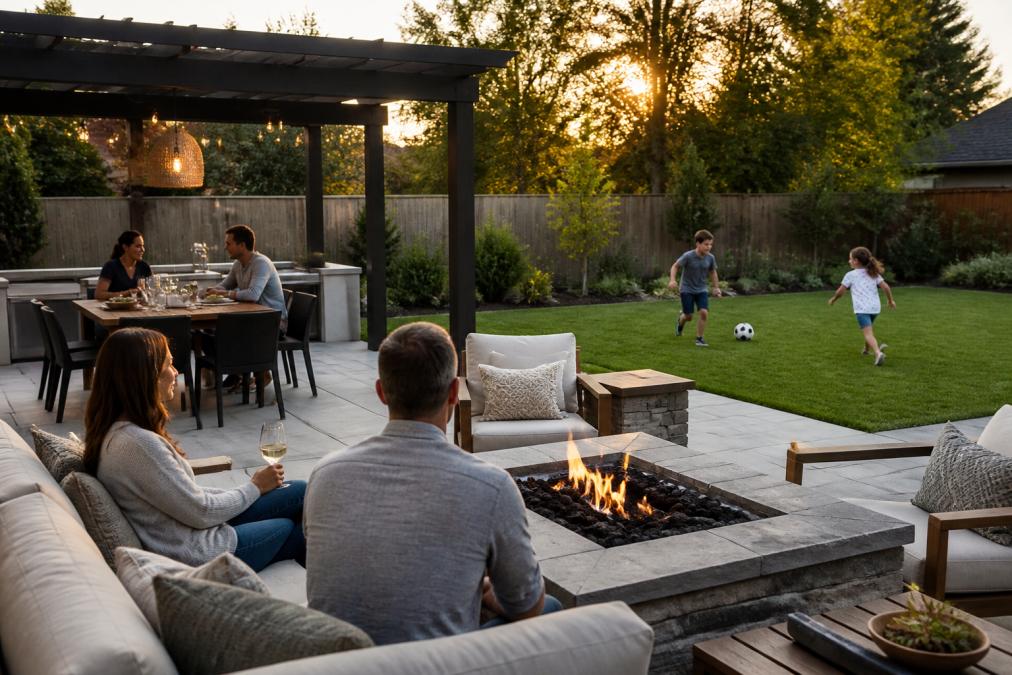
Start with dining, since it anchors the most foot traffic. Place the table near the house and grill for easy serving. Put the play area where you can see it from the kitchen, not tucked behind a shed. The lounge zone, often built around a fire pit or seating wall, belongs at the quiet end of the yard.
Hardscaping defines these boundaries: a paver edge, a low wall, or a change in ground material. Softscaping, meaning plants and turf, softens the transitions. A common mistake is making zones too small. A dining table for six needs roughly 10 by 10 feet of clear space, plus room to push chairs back (hunker.com).
Keeping Traffic Flow Clear Between Zones
Traffic flow separates a yard that feels easy from one that feels cramped. Leave a minimum 3-foot-wide path between zones, and 4 feet if people will carry food or coolers through it.
Avoid routing the main path through the play area. Kids leave toys and bikes in walkways, and adults carrying hot trays don't need that obstacle. If your yard is narrow, run the primary path along one edge and let zones open off it like rooms off a hallway.
Choosing Durable Outdoor Furniture and Shade Structures
Durable materials beat stylish materials every time in a family yard, but "durable" is a marketing word until you know what to look for. Here is how a contractor evaluates furniture and shade.
Reading Furniture Materials Like a Buyer
- Powder-coated aluminum is the default for family patios: lightweight, rust-proof, and chip-resistant. Check that welds are fully finished, not spot-welded, since unfinished joints are where corrosion starts.
- Teak and other dense hardwoods hold up for decades but need periodic oiling in dry climates. Look for mortise-and-tenon joinery rather than screws, which loosen as wood expands and contracts.
- High-density polyethylene (HDPE) wicker is the most kid-tolerant option: it won't splinter, cleans with a hose, and resists fading. Cheaper "all-weather wicker" is usually PVC over a steel frame, which rusts from the inside.
- Cushions should use solution-dyed acrylic fabric, with color baked into the fiber rather than dyed on top, so it resists fading and mildew far better than standard polyester. Quick-dry foam cores drain faster after rain and reduce the musty smell that plagues standard foam.
A practical test: lift the piece. Genuinely durable furniture is heavier than it looks because the frame is thicker. If a chair feels light and hollow, the frame is thin.
Shade Structures: Matching the Structure to the Job
Shade is not one product. Each structure solves a different problem, and the trade-offs matter more in a family yard where kids climb and wind gusts hit.
| Shade Option | Best For | Maintenance Level | Wind Resistance |
|---|---|---|---|
| Pergola | Lounge and dining zones | Low | High when anchored |
| Pavilion | Full dining cover | Low | High |
| Cantilever umbrella | Flexible seating | Medium | Medium |
| Shade sail | Play areas | Low | Medium |
A few details the table cannot capture:
- Pergolas provide partial shade unless you add louvers or a canopy. Adjustable louvers let you track the sun through the day, which matters most on west-facing patios.
- Pavilions give full cover and can carry a ceiling fan or lighting circuit, but they are permanent structures that usually require a permit and footings below the frost line.
- Cantilever umbrellas free up space under the canopy because the pole sits to the side, but they catch wind like a sail. A weighted base of at least 100 pounds, or a bolted plate, is the difference between a shade source and a projectile.
- Shade sails are the most affordable way to shade a play area, but they need tensioned anchor points on all corners. A loosely hung sail flaps, wears at the seams, and provides little shade.
Anchoring and Wind
Wind is the failure mode for every shade product. An unweighted freestanding umbrella will tip in a moderate gust, and an unanchored pergola can lift. Before you buy, check the manufacturer's wind rating and confirm the anchoring method matches your surface, whether paver patio, wood deck, or bare ground. When in doubt, over-anchor.
Where to Buy
Where you buy matters as much as what you buy. A retailer that stocks weather-resistant furniture and shade products built for local conditions, and that offers delivery and installation so frames are anchored correctly the first time, saves you the callback that comes from a structure that was set, not secured.
Outdoor Lighting for Family Safety and Ambiance
Outdoor lighting for family safety and ambiance comes down to three layers: path lights, task lights, and accent lights. Path lights at 12 to 18 inches tall keep walkways visible without glare. Task lighting over the grill and dining table lets you cook and eat after sunset. Accent lights wash walls or uplight trees for atmosphere.
Use warm-white bulbs, around 2700K, for seating areas. Cool white reads as harsh in a backyard. Put every circuit on a timer or smart switch so lights turn off on their own, and keep cords and low-voltage lines buried or clipped to prevent tripping.
Benefits of Adding a Hot Tub to Backyard Design
The benefits of adding a hot tub to backyard design extend well beyond relaxation. A spa anchors the lounge zone, giving adults a reason to stay outside after the kids go in and turning the backyard into a year-round destination rather than a summer-only space.
For families, a hot tub also solves a practical problem: it concentrates adult supervision in one spot. Parents soaking while kids play nearby can keep eyes on the yard instead of running between rooms.
Maintenance is where most spa owners get surprised. A hot tub needs consistent water chemistry, filter cleaning, and periodic water changes. allvalley hot tubs ship with free starter kits and chemicals, removing the guesswork of the first few months. Our delivery and installation teams handle setup, including the electrical coordination most homeowners don't want to manage.
Safety and Child-Proofing Your Outdoor Entertainment Space
Safety and child-proofing should be built into the plan, not added after the first scare. Every feature that makes a backyard fun, water, fire, height, also creates risk, and the fix is almost always a physical barrier plus clear rules. This is the part most planning guides skip, and the part that matters most when the yard is built for kids. Integrating these protective measures early ensures that the long-term vision for planning backyard living spaces remains both functional and secure for every member of the family.
Pool and Water Feature Barriers
If your plan includes a swimming pool, spa, or fountain, check your local code before construction. Most jurisdictions require a barrier around pools, and requirements vary by state and municipality. The U.S. Consumer Product Safety Commission pool safety information outlines barrier guidelines and safety practices worth reviewing before you finalize a layout.
A few non-negotiables for water features:
- Self-latching gates that close on their own, with latches out of a child's reach
- Covers or grates on fountains and decorative water features
- Locking spa covers rated for weight, not just weather
- No climbable furniture, planters, or equipment near the pool fence
Fire pits need the same treatment. Keep them at least 10 feet from structures and low branches, and never place them where kids run between the fire and the house.
Beyond the Pool: The Child-Proofing Most Guides Skip
Water and fire get the headlines, but the everyday hazards in a family yard are the ones nobody plans for. Walk your layout and address each of these before the first cookout:
- Non-slip surfaces. Polished concrete and smooth tile become slick when wet. Choose a textured paver, brushed finish, or non-slip coating near water, the grill, or a step. This is the single most common cause of backyard falls.
- Secure storage. Chemicals, grill tools, pool equipment, and sharp garden implements should live in a locking cabinet or a shed with a child-resistant latch. A lidded storage bench doubles as seating and keeps small hands out of things they should not reach.
- Step and edge marking. Changes in elevation are trip hazards for kids and seniors alike. Mark step edges with a contrasting material or low-level lighting so the change is visible at night.
- Plant selection. Some common landscape plants are toxic if ingested. Check any plant you add against a reputable toxic-plant list, and keep berries and seed pods out of reach of toddlers.
- Grill and equipment placement. Keep the grill at the edge of the traffic flow, not in the middle of it, and never where a child can pull a hot pan down.
Designing for Multiple Generations at Once
A yard that works for a toddler rarely works for a grandparent by accident. The two needs pull in different directions, and the design has to satisfy both:
- Level paths. A continuous, firm, level route from the house to the main seating area serves a walker, a stroller, and a wheelchair. Gravel and uneven pavers do not.
- Seating with armrests and back support. Grandparents need a chair they can rise from without help. A bench without arms is not that chair.
- Shade over seating, not just over the play area. Older skin burns faster and overheats sooner. Shade belongs where adults sit, not only where kids play.
- Sightlines in both directions. A parent at the grill should see the play area, and a grandparent in the lounge should see the pool gate. Design the layout so no one has to stand up to check on someone else.
- Quiet and active zones separated. A spa or lounge at one end and a play area at the other lets a grandparent rest while kids burn energy, without either group feeling exiled.
The goal is a single yard a three-year-old and a seventy-year-old can both use on the same afternoon. That is a layout problem, solvable at the planning stage far more cheaply than after the concrete is poured.
Maintenance and Sustainable Planning for a Family Backyard
Low-maintenance planning starts at the design stage. Choose materials and layouts that reduce ongoing work rather than adding to it.
- Use composite decking or pavers instead of wood that needs annual sealing.
- Group plants by water needs so irrigation zones stay simple.
- Install drip irrigation on a smart controller that adjusts to weather.
- Pick native or desert-adapted plants that thrive without constant attention.
- Add permeable hardscape where possible to reduce runoff.
Sustainable choices often overlap with low-maintenance ones. Shade trees cut cooling costs, permeable pavers manage rainwater, and LED lighting uses a fraction of the power of incandescent fixtures. For desert households, these aren't just environmental wins, they're practical ones that show up on utility bills.
Plan a simple annual maintenance calendar: spring inspection of structures and irrigation, summer chemistry checks on any water feature, fall cleanup, winter cover and equipment checks.
Planning a family backyard is a balance of fun, safety, and upkeep, and getting it right means choosing products that hold up and a team that stands behind the install. allvalley has spent over 26 years helping homeowners build outdoor retreats with hot tubs, BBQ equipment, fireplaces, and shade structures, backed by professional delivery and installation plus free starter kits and chemicals with every spa. Call 760-342-5277 to plan your space with a team that's been doing this since before your kids were born.
Frequently Asked Questions
What are the essential elements of a family-friendly outdoor space?
A family-friendly outdoor entertainment space typically includes distinct zones for dining, play, and lounging, durable weather-resistant furniture, shade structures like pergolas or umbrellas, and layered lighting for safety and ambiance. Safety features such as non-slip surfaces, pool barriers, and secure storage for tools or chemicals are also important. Many families add a hot tub for relaxation and a grill or outdoor kitchen for easy hosting.
How do I zone my backyard for different entertainment activities?
Start by measuring your yard and identifying sun and shade patterns. Then divide the space into functional zones: a dining area near the kitchen or grill, a play area with soft landscaping or turf, and a lounge zone with comfortable seating and a fire pit. Keep traffic flow clear between zones, and use hardscaping like pavers or decking to define each area. For families with young children, place the play zone where you can supervise from the lounge or dining area.
What safety features should be included in a family outdoor entertainment area?
Key safety features include non-slip decking or patio materials, pool and hot tub covers with locks, self-closing gates around water features, and adequate lighting on stairs and pathways. Store grill tools, chemicals, and sharp objects in locked cabinets. If you have a fire pit, keep a safe distance from seating and teach children to stay back. Also check local codes for pool barriers and electrical outlets near water.
How can I incorporate a hot tub into my backyard design?
Place your hot tub on a level, reinforced surface close to the house for easy access, but away from direct sun if you want cooler soaks in summer. Consider privacy screening with plants or a pergola, and ensure the area has good drainage. Many brands like allvalley offer delivery and installation, plus starter kits and chemicals to simplify maintenance. A hot tub can serve as a focal point in a lounge zone, encouraging family relaxation.