 how-to
How to Choose a Durable Outdoor Fireplace for Windy Areas
Table of Contents
- Why Standard Fireplaces Fail in Windy Backyards
- What to Look for in a Durable Outdoor Fireplace for Windy Areas
- Best Materials for Outdoor Fireplaces in High-Wind Zones
- Outdoor Fireplace Wind Guards and Essential Accessories
- Gas vs Wood Burning Fireplace for Wind: Which Holds Up?
- Sizing, Placement, and Micro-Climate Landscaping
- Common Mistakes to Avoid When Buying for Wind
- Conclusion: Your Wind-Ready Fire Feature Plan
- Frequently Asked Questions
Last Updated: September 9, 2026
Wind is the silent killer of backyard fire features. A fireplace that looks stunning on a calm showroom floor can turn into a smoke-blowing, heat-wasting disappointment the moment a desert breeze picks up. Choosing a durable outdoor fireplace for windy areas requires more than picking the heaviest model on the lot, and this guide from allvalley breaks down exactly what matters, from material science to placement strategy.
Most standard fireplaces fail in windy backyards because manufacturers design them for sheltered patios, not open desert lots. When gusts hit an open flame, they push heat sideways, blow smoke back into seating areas, and cause uneven fuel combustion that accelerates structural wear.
Why Standard Fireplaces Fail in Windy Backyards
The core problem is simple: an exposed flame has no defense against moving air. Wind disrupts the combustion zone, pulling heat away faster than the fire can generate it and forcing the unit to burn more fuel to maintain the same warmth.
A durable outdoor fireplace for windy areas must counteract this physics with enclosed or semi-enclosed firebox designs. Open-front models with shallow fireboxes are the most vulnerable, while units with deep fireboxes, taller throat openings, and higher chimney drafts handle gusts far better. Many homeowners in the Coachella Valley discover this only after their first windy season, when they realize their "premium" fireplace barely radiates heat and fills the yard with smoke.
What to Look for in a Durable Outdoor Fireplace for Windy Areas
Focus on three performance categories when evaluating any unit: wind speed tolerance, heat containment, and structural stability. A fireplace that scores well in these areas will function reliably even when gusts reach 20 to 30 mph.
Wind Speed Tolerance and Flame Stability
Wind speed tolerance refers to how much airflow a unit can handle before flame stability breaks down. Look for models with documented performance in breezy conditions, typically those with wind guards, baffles, or recessed burn areas. The flame should hold a steady, upright shape rather than flickering wildly or extinguishing.
Heat Containment and BTU Output Calculations
Heat containment determines how much warmth actually reaches you instead of escaping skyward. A common approach is to calculate required BTU output based on your patio size and typical wind exposure. For a 200-square-foot seating area in a moderately windy zone, you generally need a higher BTU rating than the same space in a sheltered courtyard, because wind accelerates heat loss (energy.gov).
Best Materials for Outdoor Fireplaces in High-Wind Zones
Material choice directly affects longevity in windy, dusty environments. The best materials for outdoor fireplaces in exposed areas resist both thermal stress and erosion from wind-blown particles.
Cast Concrete vs. Powder-Coated Steel vs. Stone Veneer
Cast concrete offers excellent thermal mass, absorbing heat and radiating it slowly even when gusts try to strip warmth away. It performs well in wind because its weight provides structural integrity, though it can crack if the base shifts.
Powder-coated steel resists corrosion and handles temperature swings well, but thinner gauges can dent from wind-blown debris. Stone veneer looks premium but requires a solid structural core, and the veneer itself can loosen over time if wind-driven moisture penetrates the mortar.
Outdoor Fireplace Wind Guards and Essential Accessories
Outdoor fireplace wind guards are not optional accessories in exposed yards; they are functional necessities. A quality glass wind screen encloses the flame while preserving the view, and a spark screen adds a second layer of ember containment for wood-burning units.
Glass Wind Screens, Spark Screens, and Ember Containment
Glass wind screens reduce flame flicker and improve combustion efficiency by stabilizing the airflow around the firebox. Spark screens prevent wind-carried embers from escaping and landing on nearby furniture or landscaping, a genuine fire hazard in dry conditions. Always confirm that any screen you purchase is rated for the heat output of your specific unit, and check that it creates a proper seal when closed (nfpa.org). For gas units, verify that the pilot light is protected from direct gusts, since a blown-out pilot is a common frustration in windy zones.
Gas vs Wood Burning Fireplace for Wind: Which Holds Up?
Gas units generally hold up better in wind than wood-burning models. A gas fireplace with an enclosed flame and protected ignition system maintains consistent performance because the fuel supply is controlled and the flame is not dependent on draft. Wood fires, by contrast, struggle in gusts because wind accelerates burn rates, creates uneven combustion, and sends sparks flying.
That said, gas fireplaces are not immune to wind problems. Poorly designed units can still experience flame lift-off, where the flame separates from the burner, reducing heat output. Look for gas models with wind-resistant burner designs and adequate flame shielding. Wood-burning enthusiasts can mitigate wind issues with deeper fireboxes and well-designed spark screens, but they will always fight the elements more than gas users.
Sizing, Placement, and Micro-Climate Landscaping
A durable outdoor fireplace for windy areas is only as good as its placement. Even the best unit will underperform if positioned in a wind tunnel between your house and a fence line. Observe your yard on a gusty day and identify the prevailing wind direction before committing to a location. But the real competitive advantage comes from treating your entire yard as a wind-abatement system, not just positioning one product.
Wind-Block Landscaping and Structural Placement
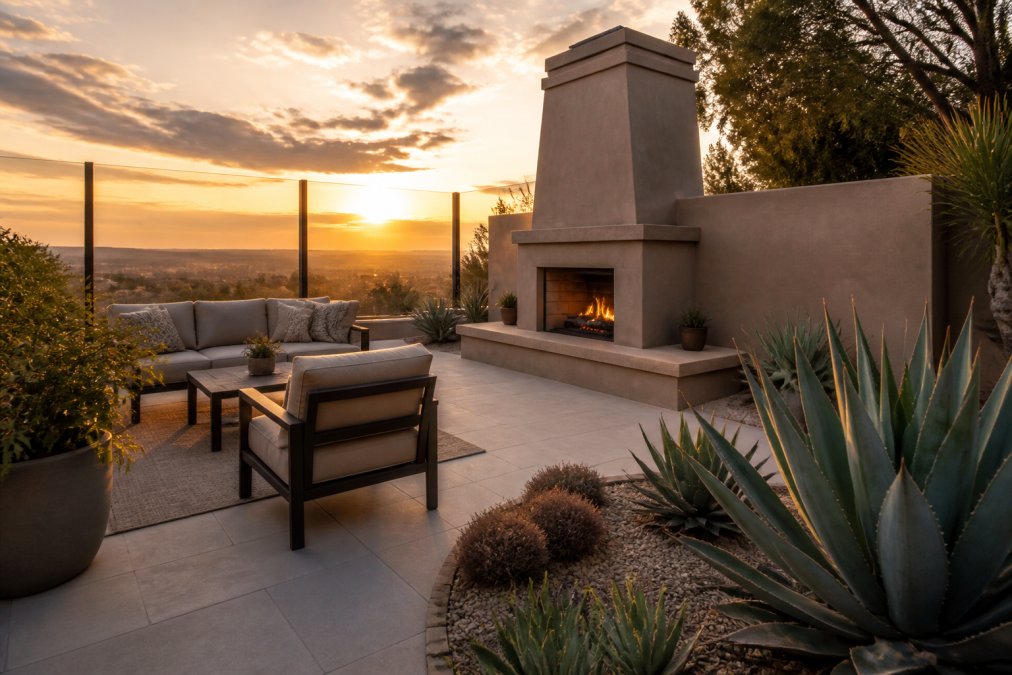
Strategic landscaping can dramatically reduce wind exposure. A row of dense shrubs, a trellis with climbing vines, or a freestanding privacy screen placed upwind of the fireplace can break the force of gusts before they reach the flame. Position the fireplace so its back faces the prevailing wind, allowing the structure itself to shield the fire. Allow at least 8 to 10 feet of clearance from overhead structures and combustible materials, and check local building codes for setback requirements before installation.
Creating a Wind Shadow: The 10x Rule
The most effective windbreaks do not stop wind entirely; they create a "wind shadow", a zone of reduced velocity that extends downwind. A well-designed windbreak reduces wind speed to roughly 25% of its open-field velocity for a distance of up to 10 times the height of the barrier (fs.usda.gov). This is the 10x rule used by landscape architects.
For a fireplace with a 6-foot-tall chimney, a windbreak of equal height placed 15 to 20 feet upwind will protect the seating area effectively. The windbreak should be semi-permeable, not solid. A solid wall creates turbulence on its leeward side, which can actually pull smoke back down into your seating area. A hedge, a row of ornamental grasses, or a slatted fence that allows 40% to 60% air passage will slow the wind without creating that destructive eddy.
Hardscape Windbreaks: Walls and Berms
For permanent solutions, consider a masonry garden wall or an earthen berm. A 3-foot-tall stone wall placed upwind of the fireplace will deflect low-level gusts that are the most disruptive to flame stability. The wall's thermal mass also absorbs heat during the day and releases it in the evening, extending the usable hours of your outdoor space. In desert climates, a rammed-earth or adobe-style wall provides both wind protection and a heat sink that complements the fireplace's radiant output.
Sizing the Fireplace to the Protected Zone
Once you have identified or created your wind-protected zone, size the fireplace to that specific area, not your entire yard. If your windbreak creates a comfortable 15 x 20-foot seating zone, you do not need a fireplace capable of heating a 40 x 40-foot open yard. This is where most homeowners over-spend and under-perform: they buy a massive unit for the whole yard, then place it in a corner where its heat is wasted. Instead, design the wind-protected zone first, then match the fireplace's BTU output and physical footprint to that zone.
Seasonal Wind Patterns and Placement
Wind direction is rarely constant. In many regions, afternoon sea breezes come from one direction, while winter storms come from another. Map your yard's wind patterns across all four seasons before pouring a concrete pad. A fireplace positioned to be sheltered from summer afternoon gusts may be fully exposed to winter northerlies. If your site has two dominant wind directions, you may need two windbreak elements, or you may need to accept that the fireplace is a three-season feature and plan the seating orientation accordingly.
Common Mistakes to Avoid When Buying for Wind
The most frequent error is prioritizing aesthetics over wind performance. A sleek, low-profile fire table may look modern, but its shallow fire pit offers zero protection from gusts. Another common mistake is skipping the wind screen to save money, only to discover that the fireplace is unusable on breezy evenings.
Under-sizing the unit is equally problematic. Homeowners often buy a fireplace rated for a smaller space, then find it cannot keep up with heat loss in an open, windy yard. Always err toward a larger BTU output than your initial calculation suggests. Finally, do not neglect the base. A tall fireplace in a windy area acts like a sail, and if the foundation is inadequate, the unit can shift or topple. Ensure the fireplace sits on a level, stable pad that meets the manufacturer's specifications.
Conclusion: Your Wind-Ready Fire Feature Plan
Choosing the right unit starts with understanding your specific wind exposure, then matching material, fuel type, and accessories to that reality. Focus on heat containment, flame stability, and structural integrity, and you will end up with a fire feature you actually use, not one that sits cold nine months of the year.
At allvalley, we have spent over 26 years helping homeowners across the Coachella Valley build backyards that work with the local climate, not against it. Our team carries fireplaces built for exposed conditions, and we handle professional delivery and installation so your unit is anchored correctly from day one. Call us at 760-342-5277 to talk through your yard's wind challenges and find a fire feature that will hold up for decades.
Frequently Asked Questions
What mph is too windy for a fire?
Most outdoor fireplaces start struggling with flame stability and heat containment when sustained winds exceed 15 to 20 mph. Gusts above 25 mph can blow embers out of wood units and extinguish gas pilot lights. Check the wind speed tolerance rating on your specific model, since enclosed flame designs and taller wind guards handle stronger conditions than open bowls or portable fire pits.
Are gas or wood-burning fireplaces better for windy backyards?
Gas fireplaces generally hold up better in wind because gas ignition systems produce a steady, enclosed flame that is less prone to being blown out than open wood fires. Wood units lose heat fast in wind and create ember containment risks. If you prefer wood, choose a model with a tall spark screen and an enclosed firebox to maintain combustion efficiency and structural integrity.
What is the best material to use for an outdoor fireplace in a windy area?
Cast concrete and powder-coated steel are the most weather-resistant choices for high-wind zones. Cast concrete offers excellent thermal mass and corrosion resistance, while powder-coated steel resists rust and structural damage from flying debris. Avoid thin sheet metal or unsealed brick, which crack or corrode quickly when exposed to wind-driven rain and temperature swings.
How do I keep my outdoor fireplace from blowing out in the wind?
Install a glass wind guard or a tall spark screen to shield the flame while maintaining ambient warmth. Position the fireplace with its opening perpendicular to the prevailing wind, or build a low privacy wall or dense shrub line as a windbreak. For gas units, verify the pilot light protection is rated for your local wind speed tolerance.