 comparison
Outdoor Kitchen: Contractor vs DIY Installation
Table of Contents
- Outdoor Kitchen Contractor vs DIY Installation: The Core Differences
- Outdoor Kitchen Installation Cost Breakdown
- Outdoor Kitchen Permit Requirements and Legal Liability
- Best Outdoor Kitchen Equipment Brands 2026
- Pros and Cons of Hiring a Professional Contractor
- DIY Installation: Pros, Cons, and Difficulty Levels
- Warranty Coverage, Maintenance, and Resale Value Impact
- Which Path Is Right for Your Project
- Frequently Asked Questions
Last Updated: August 31, 2026
Outdoor Kitchen Contractor vs DIY Installation: The Core Differences
When planning an outdoor kitchen, the decision between hiring a professional contractor and going DIY shapes your budget, timeline, warranty coverage, and code compliance. A professional contractor brings structural expertise, permitting knowledge, and liability insurance. DIY installation puts control in your hands but demands significant time, specialized tools, and willingness to troubleshoot problems yourself.
At allvalley, we've worked with homeowners on both sides of this decision. This guide breaks down the real differences so you can make the decision that fits your situation, skills, and risk tolerance.
Outdoor Kitchen Installation Cost Breakdown
Understanding true costs requires separating material expenses from labor, permits, and hidden costs that catch most homeowners off guard.
Contractor Pricing and Labor
When you hire a professional contractor, labor typically represents 40-60% of the total project cost for a custom outdoor kitchen (nahb.org). Contractors handle project management, site assessment, permit coordination, and warranty coverage. They source materials at wholesale rates but pass through their markup. A professional crew completes a standard installation in 2-4 weeks.
DIY Material and Equipment Costs
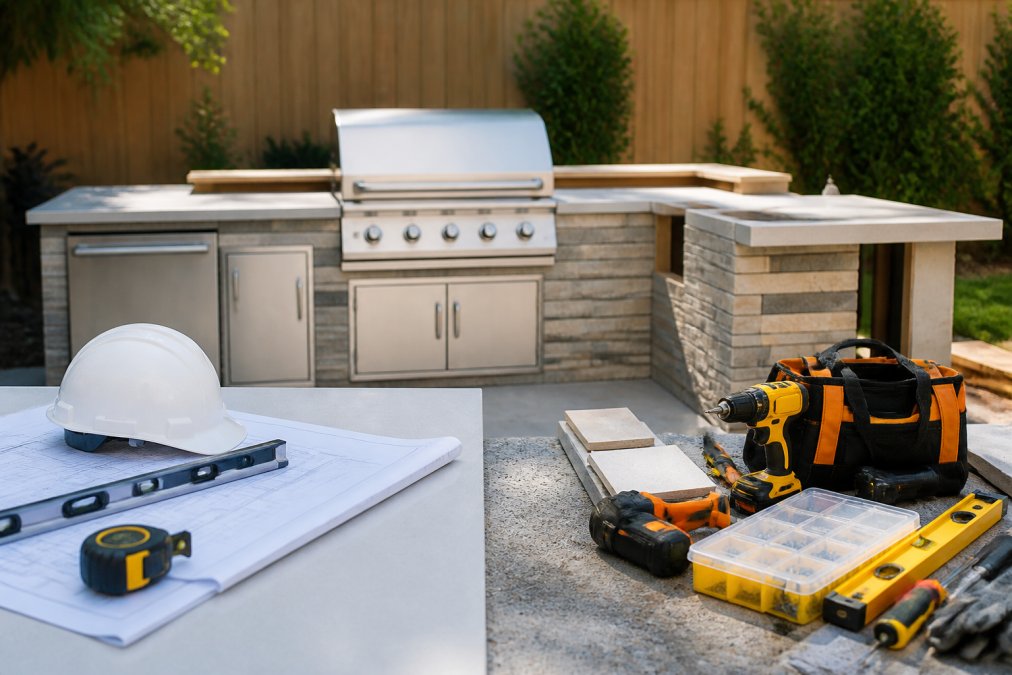
Going DIY eliminates labor but introduces equipment rental and tool costs. Budget $300-800 for essential equipment if you don't already own a level, power drill, circular saw, and basic hand tools. Specialized tools for masonry or gas line connections can add another $400-1,200.
Material costs depend on whether you choose prefab modular systems or custom builds. You avoid contractor markup on materials but buy at retail prices.
Hidden Costs Both Paths Share
Permitting fees typically range from $200-1,500 depending on jurisdiction and project scope (iccsafe.org). Utility connections, gas lines, electrical runs, water supply, and drainage, often cost more than homeowners expect. Site preparation including grading, foundation work, and structural reinforcement is essential but frequently underestimated by DIY builders.
Outdoor Kitchen Permit Requirements and Legal Liability
Permits exist for safety reasons, and violations create legal and financial liability.
When Permits Are Required
Most jurisdictions require permits for outdoor kitchens with permanent structures, gas connections, electrical work, or plumbing. Check with your local building department before starting any work. The cost of a permit is trivial compared to removing an unpermitted structure or facing fines.
Building Code Compliance and Safety Standards
Building codes dictate minimum standards for structural integrity, ventilation, electrical safety, and gas line installation. Gas line installation requires specific materials, pressure testing, and inspection. Electrical work must meet the National Electrical Code standards for outdoor environments (nfpa.org). Improper installation can cause fires, explosions, or electrocution.
A licensed contractor knows these codes and builds to them automatically. A DIY builder must research, understand, and execute to the same standards. Many DIY projects fail inspection because the builder didn't account for code requirements they didn't know existed.
Who Bears Responsibility for Violations
If your outdoor kitchen violates building codes, you bear the legal and financial responsibility. If someone is injured due to a code violation you created, liability falls on you. Your homeowner's insurance may not cover injuries caused by unpermitted or non-compliant work.
If you sell your home, a building inspector may flag code violations. You'll need to remediate them at contractor rates or accept a reduced sale price. A licensed contractor carries liability insurance and assumes responsibility for code compliance.
Best Outdoor Kitchen Equipment Brands 2026
Equipment quality varies dramatically and affects both DIY feasibility and long-term durability.
Professional-Grade Cabinetry and Appliances
Danver Outdoor Kitchens manufactures 100% 304-grade stainless steel cabinetry designed for custom outdoor kitchens in hundreds of configurations with soft-close drawers and powder coat finishes. Danver cabinets represent the high end of the durability spectrum.
Kalamazoo Outdoor Gourmet produces hybrid fire grills that cook with gas, wood, or charcoal simultaneously, featuring laser-cut cooking surfaces and marine-grade stainless steel construction.
For homeowners seeking professional-grade equipment without custom design complexity, allvalley offers top-quality BBQ equipment, fireplaces, and outdoor living components with professional delivery and installation services. With over 26 years of experience, allvalley focuses on reliable, low-maintenance products that minimize ongoing hassles.
Modular and Ready-to-Assemble Options
RTA Outdoor Living provides modular outdoor kitchen islands in prefab configurations. Their design tool lets you build a 3D model, see instant pricing, and preview the island in your yard using augmented reality. The islands integrate Coyote appliances and appeal to DIY builders because assembly is straightforward.
OutdoorBrite uses AI to generate realistic outdoor kitchen designs on photos of your actual yard. Upload a photo, describe your desired layout, and the tool renders multiple concepts in under a minute. It's useful for visualization but doesn't provide construction plans or detailed specifications.
Modular systems reduce DIY complexity significantly. You're assembling pre-engineered components rather than building from scratch.
Pros and Cons of Hiring a Professional Contractor
Contractors handle the entire project scope from permitting to final inspection.
Advantages of Professional Installation
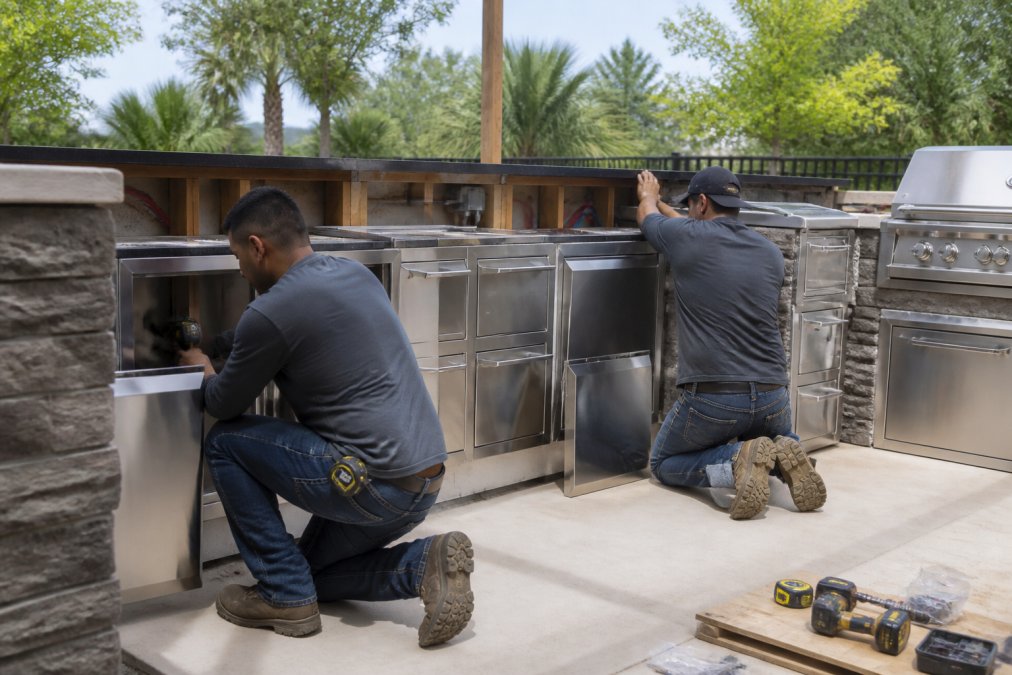
A contractor assumes responsibility for permits, inspections, and code compliance. They know local requirements, handle paperwork, and ensure your installation passes inspection. Contractors bring specialized tools and equipment and have relationships with suppliers for wholesale pricing. Their efficiency means faster completion, typically 2-4 weeks.
Warranty coverage is significant. Most contractors guarantee their labor for 1-2 years and often provide extended warranty options on materials. Liability insurance protects you if a worker is injured or their work causes property damage. Professional installation handles structural integrity and utility integration correctly, with gas lines pressure-tested and electrical circuits properly grounded.
Drawbacks and Considerations
Cost is the obvious drawback, with labor typically adding 40-60% to material expenses. Contractor quality varies significantly, requiring careful vetting, reference checks, and verification of licensing and insurance. You're scheduling around the contractor's availability, not your own. Customization is sometimes limited if your vision deviates from their standard approach.
DIY Installation: Pros, Cons, and Difficulty Levels
DIY appeals to people who want control, lower costs, and the satisfaction of building something themselves.
Advantages of the DIY Approach
Cost savings are real if you do most of the work yourself. For a modular outdoor kitchen using prefab components, you might save 30-50% compared to contractor pricing. You design exactly what you want, source components you prefer, and work at your own pace. The learning experience has value if you're inclined toward DIY projects.
Real Challenges and Limitations
Time investment is substantial. A DIY outdoor kitchen takes months, not weeks. Utility connections require specialists, reducing your labor savings. Code compliance is your responsibility, and violations discovered at inspection are expensive to fix. Structural integrity depends entirely on your execution, with problems often appearing months or years later. Warranty coverage is minimal or nonexistent for DIY work.
Tools and Skills Required
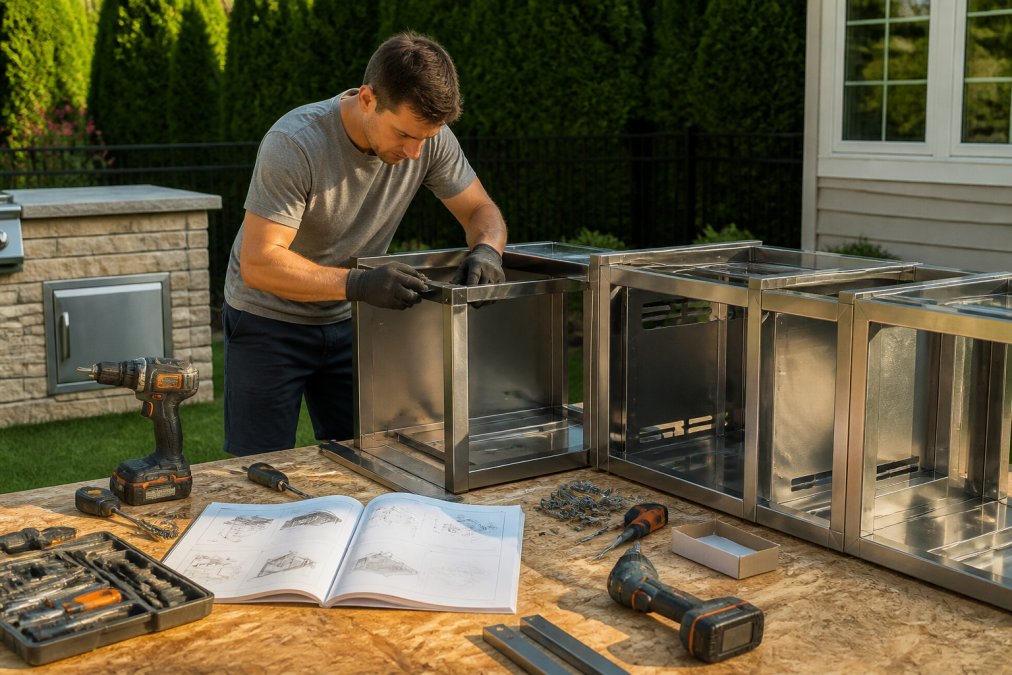
Basic DIY projects require a standard toolkit costing $300-800. Prefab modular systems require assembly skills, following instructions, and basic problem-solving. Most homeowners can handle this at moderate difficulty. Custom builds or masonry work require advanced skills or willingness to learn through trial and error. Utility work requires licensed professionals in most areas.
Warranty Coverage, Maintenance, and Resale Value Impact
Installation method affects how your outdoor kitchen performs over time and what happens if problems arise.
How Installation Method Affects Warranty
Contractor-installed work typically carries a 1-2 year labor warranty. The contractor guarantees their workmanship and remedies defects at no cost. DIY installations have no labor warranty. Appliances carry manufacturer warranties, but structural elements and custom work are your responsibility.
Long-Term Maintenance and Durability
Professional installation typically lasts longer because the work is done correctly the first time. Proper drainage, adequate ventilation, correct utility sizing, and structural integrity all contribute to durability. A well-installed outdoor kitchen functions reliably for 15-20 years with routine maintenance.
allvalley emphasizes products designed for low maintenance, stainless steel components that resist corrosion, and systems requiring minimal seasonal work. Proper installation amplifies these benefits.
Property Value and Buyer Appeal
A well-executed outdoor kitchen adds resale value, with buyers often valuing it at 50-80% of the installation cost. An unpermitted or code-violating outdoor kitchen reduces property value and creates negotiating leverage for price reductions. A professionally installed outdoor kitchen signals quality and durability.
| Aspect | Contractor Installation | DIY Installation |
|---|---|---|
| Labor Cost | 40-60% of total project | Eliminated if you do the work |
| Timeline | 2-4 weeks | 3-6 months or longer |
| Permitting | Contractor handles | Your responsibility |
| Code Compliance | Contractor ensures | Your responsibility |
| Warranty | 1-2 years labor warranty | No labor warranty |
| Utility Work | Licensed professionals | Must hire specialists anyway |
| Resale Value Impact | Positive (adds perceived value) | Variable (depends on quality) |
| Risk of Violations | Low (contractor expertise) | High (learning curve) |
| Customization | Good (within contractor scope) | Excellent (full control) |
| Maintenance | Low (proper installation) | Variable (depends on execution) |
Which Path Is Right for Your Project
The decision hinges on four factors: budget, timeline, complexity, and your comfort with risk.
Choose a contractor if: You want the project completed quickly with guaranteed code compliance, warranty protection, and professional liability coverage. Your budget accommodates labor costs. The project includes complex utility work or custom design. You prioritize reliability and resale value over cost savings.
Choose DIY if: You have significant time available and enjoy hands-on projects. You're using modular prefab systems with straightforward assembly. Budget is the primary constraint. You're comfortable hiring specialists for utility work and handling permitting yourself.
Hybrid approach: Many homeowners purchase components from allvalley or similar retailers, handle assembly themselves for modular systems, and hire contractors for permitting, utility connections, and final inspections. This approach captures some labor savings while mitigating code compliance and utility risks.
Outdoor kitchens are complex projects. A contractor's cost premium buys expertise, warranty coverage, and liability protection. DIY saves money but demands time, skill, and risk tolerance.
Building an outdoor kitchen is a significant investment in your home and lifestyle. If you're in the Coachella Valley or Riverside County area and want professional guidance on your options, allvalley has spent over 26 years helping homeowners navigate this exact decision. Whether you need delivery and installation services, equipment selection advice, or a fully managed project, allvalley brings experience, quality products, and a commitment to getting it right. Call us at 760-342-5277 to discuss your project and get a clear understanding of your best path forward.
Frequently Asked Questions
What is the typical cost of installing an outdoor kitchen?
Outdoor kitchen installation costs vary widely based on size, materials, appliance quality, and whether you hire a contractor or go DIY. Professional installation typically ranges higher due to labor, permits, and site preparation. DIY projects can cost less upfront but may require renting specialized tools and addressing unforeseen structural issues. Pricing depends on quantity, dates, and delivery. Contact allvalley for a custom quote tailored to your specific project needs and backyard layout.
What permits are required for outdoor kitchen installations?
Most jurisdictions require permits for outdoor kitchens, especially those involving gas lines, electrical connections, or permanent structures. Building permits ensure your installation meets local building codes and safety standards. Gas line installation and electrical work typically require licensed professionals and inspections. Drainage and foundation preparation may also trigger permitting requirements. Hiring a professional contractor often simplifies the permitting process, as they handle applications and inspections. Check with your local building department for specific requirements in your area.
Is it better to DIY or hire a contractor for outdoor kitchen projects?
The choice depends on your budget, skills, timeline, and project complexity. DIY installation saves labor costs and gives you full control over the design, but requires significant time, specialized tools, and knowledge of building codes and utility hookups. Professional contractors handle permits, inspections, and complex tasks like gas line installation and electrical work, ensuring code compliance and warranty coverage. For complex projects involving masonry, hardscaping, or utility access, professional installation reduces risk and ensures structural integrity and finish quality.
How does professional installation impact the warranty of outdoor kitchen equipment?
Most appliance manufacturers require professional installation to honor their warranty. DIY installation may void warranties on high-end equipment, leaving you responsible for repairs or replacements. Professional contractors often provide their own labor warranty, covering workmanship defects. Professional installation also ensures proper appliance integration, ventilation requirements, and utility connections, protecting both your warranty and the longevity of your outdoor kitchen.
What are the hidden costs of DIY outdoor kitchen construction?
Beyond material and equipment costs, DIY projects often face unexpected expenses: tool rentals for specialized equipment, permits and inspections you must apply for yourself, structural repairs or foundation preparation your initial estimate missed, utility upgrades for gas line installation or electrical code compliance, and potential mistakes requiring costly corrections. Climate-specific considerations like drainage solutions for your region may add expense. If you need to hire professionals to fix code violations or redo sections, costs multiply quickly. Professional contractors factor these into their estimates, preventing budget surprises.
This article was written using GrandRanker