 ultimate-guide
Is an Outdoor Kitchen Worth the Cost? A 2026 Review
Table of Contents
- The Real Return on Investment: How an Outdoor Kitchen Affects Property Value
- Average Cost of Outdoor Kitchen Installation in 2026
- Best Outdoor Kitchen Equipment Brands 2026: What to Look For
- Outdoor Kitchen Maintenance Tips That Protect Your Investment
- Pros and Cons of Building an Outdoor Kitchen
- The Minimalist Alternative: When a Full Outdoor Kitchen Isn't Worth It
- Frequently Asked Questions
Last Updated: September 10, 2026
The Real Return on Investment: How an Outdoor Kitchen Affects Property Value
Whether an outdoor kitchen is worth the cost depends less on the build itself and more on how well it fits your property, your climate, and how long you plan to stay. This guide from allvalley breaks down the real numbers behind the decision.
Homeowners across the Coachella Valley and Riverside County ask us this constantly, and the honest answer is: it depends on execution. An outdoor living space that extends usable square footage and matches the home's architecture tends to hold value well. One that's oversized for the lot or built with materials that can't survive desert heat often doesn't.
What Appraisers Actually Look For
Appraisers treat outdoor kitchens as an extension of the home's functional living area, not as a standalone luxury. According to appraisal guidance from the Appraisal Institute, permanent built-in features that are safely installed and consistent with the neighborhood carry more weight than freestanding or portable setups.
Three factors move the needle most:
- Permanence: Built-in grills, masonry counters, and hardscaped patios read as real improvements. A rolling cart and a folding table do not.
- Integration: Structures that match the roofline, flooring, and materials of the house appraise higher than mismatched additions.
- Condition: Cracked countertops, rusted frames, or non-functional gas lines drag value down rather than up.
A fourth factor that gets less attention is documentation. Appraisers and buyers both respond better when you can show permits, inspection sign-offs, and receipts for the gas, electrical, and plumbing work. An unpermitted kitchen is often valued as if it were a portable grill, no matter how much it cost to build (appraisalinstitute.org).
Cost Recovery: What You Get Back at Resale
Cost recovery for outdoor kitchens varies widely by market, build quality, and, more than almost any other factor, climate. The same $30,000 kitchen can be a strong asset in one market and a slow-selling novelty in another.
A useful way to think about it is in three climate bands:
- Year-round outdoor markets (much of California, the Southwest, and coastal Florida): Buyers can use the kitchen 10-12 months a year, so it functions like an extra room. In these markets, well-integrated mid-range kitchens commonly recover a substantial share of their cost at resale, and premium builds in strong neighborhoods can approach full recovery.
- Three-season markets (Mid-Atlantic, Pacific Northwest, much of the South): Usable roughly 6-9 months. Recovery is moderate and depends heavily on whether the kitchen is covered or adjacent to a screened porch.
- Short-season markets (Upper Midwest, Mountain West, Northeast): Usable 3-5 months. Buyers here often view an elaborate outdoor kitchen as a maintenance liability rather than an amenity, and recovery can be weak unless the home already sits in a neighborhood where outdoor entertaining is the norm.
The single biggest mistake is treating the kitchen as a standalone project rather than part of a broader outdoor living space. Buyers evaluate the patio, landscaping, and kitchen as one package. A gorgeous grill island surrounded by bare dirt is a liability, not an asset.
Average Cost of Outdoor Kitchen Installation in 2026
There's no single average cost of outdoor kitchen that applies to every project. Pricing depends on size, materials, appliance tier, and how much infrastructure work your yard requires. Any contractor quoting a flat number without a site visit is guessing.
Budget, Mid-Range, and High-End Tiers
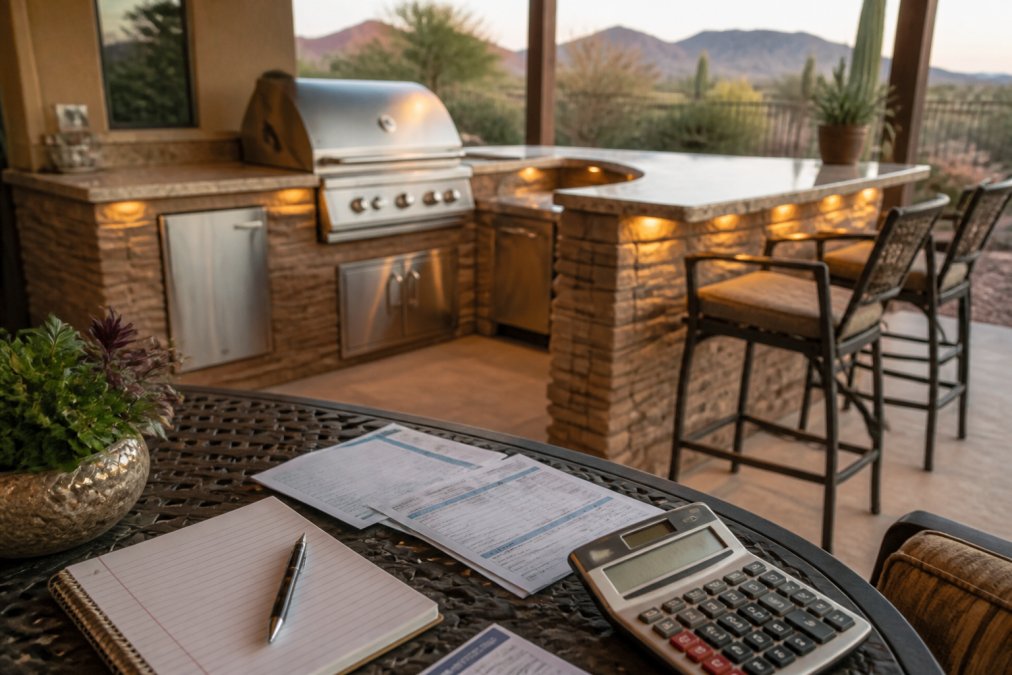
Most projects land in one of three tiers, distinguished mainly by countertop materials, appliance brands, and whether the space is covered.
| Tier | Typical Scope | Key Cost Drivers | Best For |
|---|---|---|---|
| Budget | Grill, small counter, basic patio | Prefab components, fewer utilities | First-time buyers testing the concept |
| Mid-range | Built-in grill, sink, bar seating, hardscaping | Custom countertops, one utility run | Most homeowners planning to stay 5+ years |
| High-end | Full kitchen, fridge, fireplace, covered structure | Custom masonry, full plumbing and electrical | Entertainers and premium properties |
Hidden Infrastructure Costs Most Homeowners Miss
The line items that blow up budgets are almost never the appliances. They're the infrastructure: gas lines, plumbing, electrical, and permits. A kitchen that looks straightforward on paper can double in cost once trenching and code compliance enter the picture.
Common hidden costs include:
- Running a dedicated gas line from the meter to the grill
- Extending plumbing for a sink and drain
- Adding GFCI-protected electrical circuits for lighting and refrigeration
- Pulling permits and scheduling inspections
- Reinforcing or expanding the patio slab to support masonry
Best Outdoor Kitchen Equipment Brands 2026: What to Look For
The best outdoor kitchen equipment brands in 2026 share three traits: heat-tolerant construction, widely available replacement parts, and clear warranty terms. Brand reputation matters less than whether you can get a burner or igniter replaced in five years.
Focus on these specifications:
- Stainless steel grade: 304-grade stainless resists corrosion far better than lower grades in desert and coastal conditions.
- BTU output and burner design: Higher BTU isn't automatically better. Even heat distribution matters more for cooking results.
- Warranty structure: Look for lifetime coverage on the firebox and a clear parts timeline on everything else.
- Service network: A brand with regional dealers and stocked parts beats a cheaper one you can't get serviced.
ENERGY STAR guidance on outdoor appliances is worth checking for efficiency ratings if you're adding refrigeration.
Outdoor Kitchen Maintenance Tips That Protect Your Investment
Outdoor kitchen maintenance tips come down to protecting three things: surfaces, connections, and covers. Consistent, low-effort care is what separates a kitchen that still looks new after a decade from one that's faded in three years.
- Clean stainless surfaces monthly with a non-abrasive cleaner
- Inspect gas connections and hoses each season
- Seal natural stone countertops annually
- Cover the grill between uses during dusty or windy periods
- Check for rust or corrosion at fasteners and hinges twice a year
- Clear burners and drip trays before heavy entertaining seasons
What Maintenance Actually Costs Over Time
Most articles stop at installation cost. The number that actually determines whether an outdoor kitchen is worth it over a 10-year horizon is the annual cost of ownership, and it's the number almost no buyer factors in.
A realistic annual budget for a mid-range kitchen breaks down roughly like this:
- Cleaning supplies and stainless polish: modest, but recurring, think a few hundred dollars a year if you keep up with it.
- Stone sealing: natural stone countertops need resealing once a year. DIY kits run well under $100; hiring it out typically runs a few hundred dollars per visit.
- Burner, igniter, and hose replacement: the most variable line item. A single igniter is inexpensive, but a full burner set on a large grill can run into the hundreds. Plan on replacing something every 2-3 years.
- Grill cover replacement: covers degrade in UV and dust. Expect to replace one every 2-4 years.
- Deep cleaning or professional service: optional, but many homeowners pay for an annual tune-up.
Across those categories, a reasonable planning figure for a mid-range kitchen is a few hundred to roughly a thousand dollars a year, far less than replacing a neglected kitchen, and far more than most buyers assume when they sign the contract. construction cost breakdown.
Winterization and Climate-Specific Care
Maintenance cost is not the same everywhere. In a year-round climate, the kitchen stays in service and the main costs are cleaning and part wear. In a short-season climate, you add winterization: shutting off and blowing out gas and water lines, covering or storing appliances, and inspecting for freeze damage in spring. That's an extra few hours of labor and, if you hire it out, an extra line item every fall.
Coastal and desert environments each add their own tax. Coastal air accelerates corrosion on fasteners and hinges; desert dust and UV degrade covers, seals, and finishes faster than most owners expect. Neither is a reason to skip the kitchen, both are reasons to budget for the maintenance instead of being surprised by it.
Pros and Cons of Building an Outdoor Kitchen
An outdoor kitchen is worth it when you'll use it regularly and plan to stay in the home long enough to enjoy the lifestyle upgrade. It's not worth it when the space would sit unused or the budget would be stretched thin.
Pros:
- Extends usable living space year-round in mild climates
- Strengthens resale appeal when well-integrated
- Reduces indoor cooking heat and utility bills during summer
- Creates a natural gathering space for backyard entertaining
- Adds a durable, low-maintenance hardscaped feature
Cons:
- High upfront cost with no guaranteed full recovery at resale
- Requires ongoing maintenance to preserve appearance and function
- Climate and seasonal usage affect how often you can actually use it
- Poor placement or overbuilding can hurt rather than help value
- Hidden infrastructure costs can push the project well over budget
The Minimalist Alternative: When a Full Outdoor Kitchen Isn't Worth It
A full outdoor kitchen isn't worth the cost if you entertain a few times a year or you're unsure how long you'll stay in the home. A minimalist setup captures most of the benefit for a fraction of the investment.
The minimalist approach means a quality built-in grill, a compact hardscaped counter, and simple seating. No sink, no refrigerator, no covered structure. You get the core experience of cooking and gathering outside without the plumbing, electrical, and permitting complexity that drives most of the cost.
This path makes sense when:
- Your budget is tight and you'd rather not finance the project
- Your yard lacks easy access to gas, water, or power
- You're testing whether outdoor cooking fits your lifestyle
- You plan to move within a few years
If any of those apply, start small. You can always expand later, and a well-built minimalist setup holds its own at resale.
Deciding whether an outdoor kitchen is worth the cost comes down to matching the build to your property, your habits, and your timeline. At allvalley, we've spent over 26 years helping homeowners across the Coachella Valley and Riverside County get that match right, with professional delivery and installation services, premium BBQ equipment, and overstock pricing that keeps quality within reach. Our products are built to minimize maintenance so your outdoor retreat stays ready for fun. Call us at 760-342-5277 and get started on a backyard you'll actually use.
Frequently Asked Questions
What are the downsides of having an outdoor kitchen?
The main downsides are upfront cost, ongoing maintenance, and weather exposure. Appliances and countertops need regular cleaning and seasonal protection, especially in desert climates with extreme heat and dust. You will also need to budget for gas lines, electrical wiring, and permits if you want a fully functional setup. Some homeowners find they use the space less than expected during peak summer months, which lowers the practical return on their investment.
How much should I budget for an outdoor kitchen?
Your budget depends on size, materials, and whether you need new gas lines, plumbing, or electrical work. A basic setup with a built-in grill and countertop costs significantly less than a full kitchen with a refrigerator, sink, and bar seating. Always factor in permits and infrastructure costs, which can add thousands. Contact allvalley for a quote based on your specific layout and appliance choices.
How much does an outdoor kitchen add to home value?
Real estate professionals often note that outdoor living spaces improve resale appeal, particularly in markets where year-round outdoor entertaining is common. The actual value added depends on your local market, the quality of materials, and how well the kitchen integrates with your overall backyard design. High-quality, weather-resistant builds with stainless steel appliances and durable countertops tend to appraise better than prefabricated units that show wear quickly.
Do outdoor kitchens require significant maintenance?
Maintenance is moderate but consistent. You will need to clean grill grates, protect countertops from staining, and check gas connections seasonally. In hot, dusty climates, covers and regular wipe-downs extend the life of your equipment. Choosing weather-resistant materials and stainless steel components reduces long-term maintenance costs. Following outdoor kitchen maintenance tips like seasonal deep cleans and prompt repair of small issues prevents bigger expenses down the road.
What equipment is essential for a functional outdoor kitchen?
The essentials are a built-in grill, a durable countertop for prep work, and storage for tools and fuel. Many homeowners add a side burner, refrigerator, and sink for full functionality. If you entertain often, consider a bar area and lighting. The best outdoor kitchen equipment brands in 2026 focus on weather resistance and warranty coverage, so prioritize those features over cosmetic upgrades when building your setup.