 how-to
Installing Outdoor Fire Features Safely: 2026 Guide
Table of Contents
- Start Here: What Installing Outdoor Fire Features Safely Actually Requires
- Outdoor Fireplace Permit Requirements You Need Before You Build
- Outdoor Fire Pit Clearance Requirements and Buffer Zones
- Non-Combustible Materials for Fire Pits and Fireplaces
- Gas Line Installation and Shut-Off Valve Safety
- Climate, Insurance, and Liability: What Coachella Valley Homeowners Often Overlook
- Post-Installation Safety Inspection Checklist for Outdoor Fire Features
- Frequently Asked Questions
Last Updated: August 10, 2026
Start Here: What Installing Outdoor Fire Features Safely Actually Requires
Installing outdoor fire features safely requires more than selecting a product. At allvalley, we've spent over 26 years helping Coachella Valley and Riverside County homeowners get this right. Most mistakes aren't about product selection, they're about skipping the groundwork: permits, clearance distances, non-combustible materials, and gas line safety.
Here's what most guides get wrong: they treat fire feature installation as a home improvement project. It's actually a code compliance project that happens to improve your home.
The consequences of cutting corners are serious. Unpermitted fire features void homeowner's insurance, trigger local fines, and create personal liability if someone is injured. In the Coachella Valley, where wind events are common and vegetation dries out fast, the margin for error is smaller than in most parts of the country.
This guide covers everything Riverside County homeowners need to know: permit requirements, clearance distances, material specifications, gas line safety, and the climate and insurance factors most installation guides ignore.
Outdoor Fireplace Permit Requirements You Need Before You Build
Outdoor fireplace permit requirements exist at multiple levels: state fire code, county ordinance, and local city or HOA rules. All three can apply simultaneously, and the most restrictive one governs.
In California, outdoor fireplaces and fire pits are regulated under the California Fire Code. Riverside County enforces additional fire safety ordinances through the Riverside County Fire Department. If you live within an incorporated city like Palm Desert, Palm Springs, or Indio, that city's building department adds another layer.
The general rule: any permanent, built-in outdoor fireplace requires a building permit. Many prefabricated gas fire pits and fire tables do not require a permit if they're portable and connected via a flexible gas line to an existing outlet, but "portable" has a specific legal meaning. If you anchor it to a pad or run a dedicated gas line, permit requirements kick in.
According to California Department of Forestry and Fire Protection (CAL FIRE) fire safety guidelines, homes in State Responsibility Areas (SRAs) face additional restrictions, including seasonal burn bans that affect wood-burning fire features.
How to Check Local Building Codes in Riverside County
Start with the Riverside County Building and Safety Department. Their online portal lets you search permit requirements by project type. For incorporated cities, contact that city's planning or building department directly.
Steps to confirm your permit requirements:
- Identify your parcel's jurisdiction (county or incorporated city)
- Determine whether your fire feature is permanent or portable
- Check your HOA's CC&Rs; many Coachella Valley HOAs ban wood-burning features
- Contact the building department to confirm setback requirements and fuel type restrictions
- Submit permit application with a site plan showing your fire feature's location relative to structures, property lines, and overhead utilities
Permit fees and timelines vary by jurisdiction. Budget at least two to four weeks for permit processing before scheduling installation.
What Happens If You Skip the Permit
Unpermitted fire features create compounding problems. Insurance companies can deny claims if a fire originates from an unpermitted structure. The county can issue a stop-work order and require demolition. When you sell the home, an unpermitted feature must be disclosed or removed.
Outdoor Fire Pit Clearance Requirements and Buffer Zones
Outdoor fire pit clearance requirements are the most commonly violated aspect of fire feature installation. The standard minimum clearance for a wood-burning fire pit in California is 10 feet from any structure, combustible fence, or overhead obstruction, though local codes frequently require more.
Clearance is measured from the outer edge of the fire pit or firebox, not the center. This distinction matters when positioning a 36-inch fire pit ring on a patio.
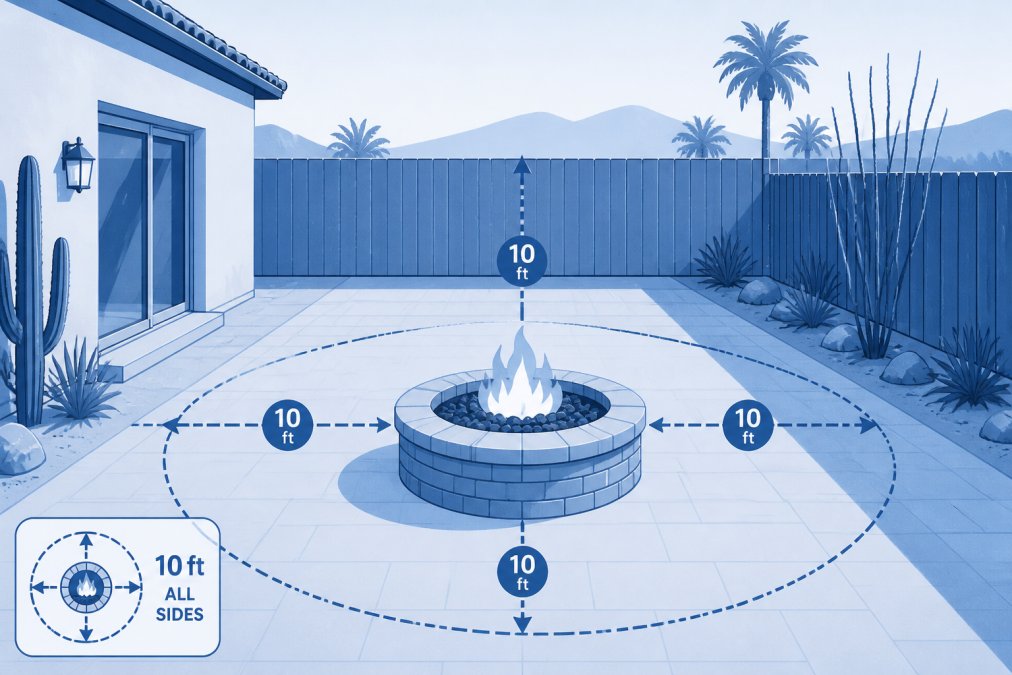
Key clearance zones to establish before installation:
- Structures (walls, eaves, pergolas): Minimum 10 feet; 15 feet recommended for wood-burning features
- Combustible fencing: Minimum 10 feet
- Overhead utilities: Minimum 25 feet (check with your utility provider)
- Property lines: Varies by jurisdiction; commonly 10-15 feet
- Vegetation and landscaping: Minimum 10 feet from any combustible plant material
The National Fire Protection Association (NFPA) outdoor fire safety standards provide the baseline clearance framework that most California jurisdictions build on.
Clearance Distances for Gas vs. Wood-Burning Fire Features
Gas fire features generally allow tighter clearances than wood-burning ones because they produce no flying sparks and can be shut off instantly. Many manufacturers specify clearances in their installation manuals, and those specs must be followed to maintain warranty coverage and code compliance.
For gas fire features, a common minimum is 36 inches from any combustible surface. For wood-burning fire pits, the 10-foot rule is the floor, not the target. In a windy desert environment, treating 10 feet as sufficient is a mistake.
A buffer zone should be non-combustible hardscape, pavers, decomposed granite, or concrete, not landscaping, mulch, wood furniture, or synthetic turf.
Non-Combustible Materials for Fire Pits and Fireplaces
Non-combustible materials will not ignite, burn, or contribute to fire spread when exposed to the heat levels produced by an outdoor fire feature. Selecting the right materials is a code requirement and a basic safety standard.
Materials that meet non-combustible standards include:
- Concrete block and poured concrete
- Natural stone (granite, limestone, travertine, flagstone)
- Brick and fire brick (for high-heat zones, fire brick rated for 2,000°F or higher)
- Steel and cast iron
- Ceramic and porcelain tile (rated for outdoor, high-heat applications)
Materials to avoid entirely:
- Pressure-treated lumber anywhere near the firebox
- River rocks and wet stones (they can crack or explode when heated rapidly)
- Synthetic decking materials within the clearance zone
- Standard concrete pavers not rated for high heat directly adjacent to the firebox
Foundation and Base Options That Meet Code
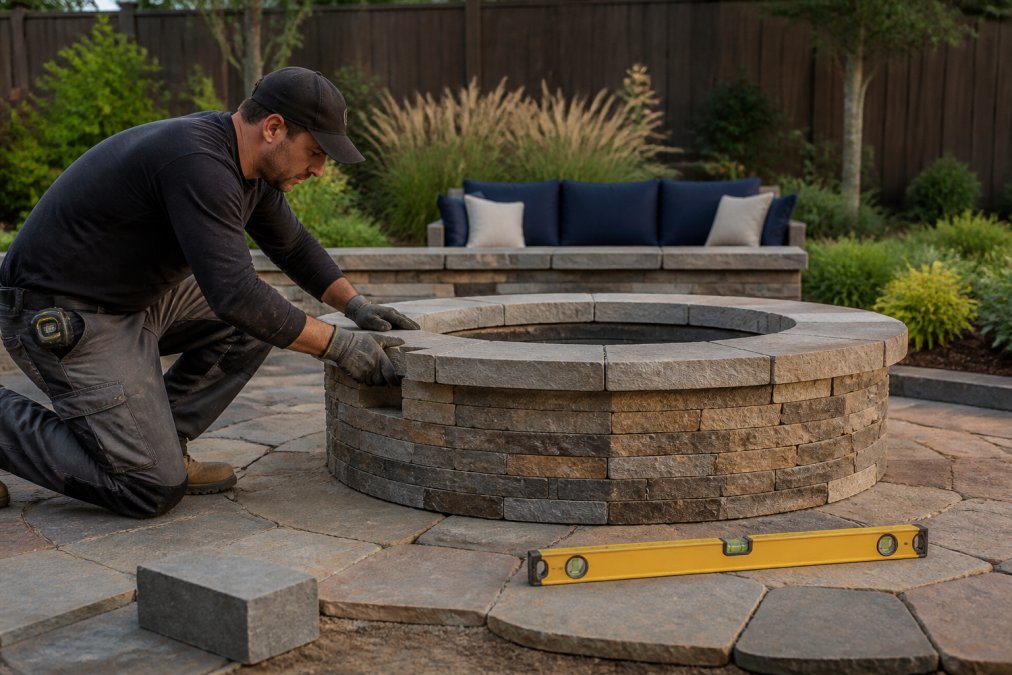
A fire-safe foundation is the base layer your fire feature sits on. For a ground-level fire pit, this typically means a minimum 4-inch concrete pad or a layer of compacted decomposed granite with concrete pavers on top.
The foundation serves two functions: structural integrity and heat dissipation so heat doesn't transfer into combustible soil or a wood deck below.
Never install a gas or wood-burning fire feature directly on a wood deck without a purpose-built, code-compliant deck fire pit system.
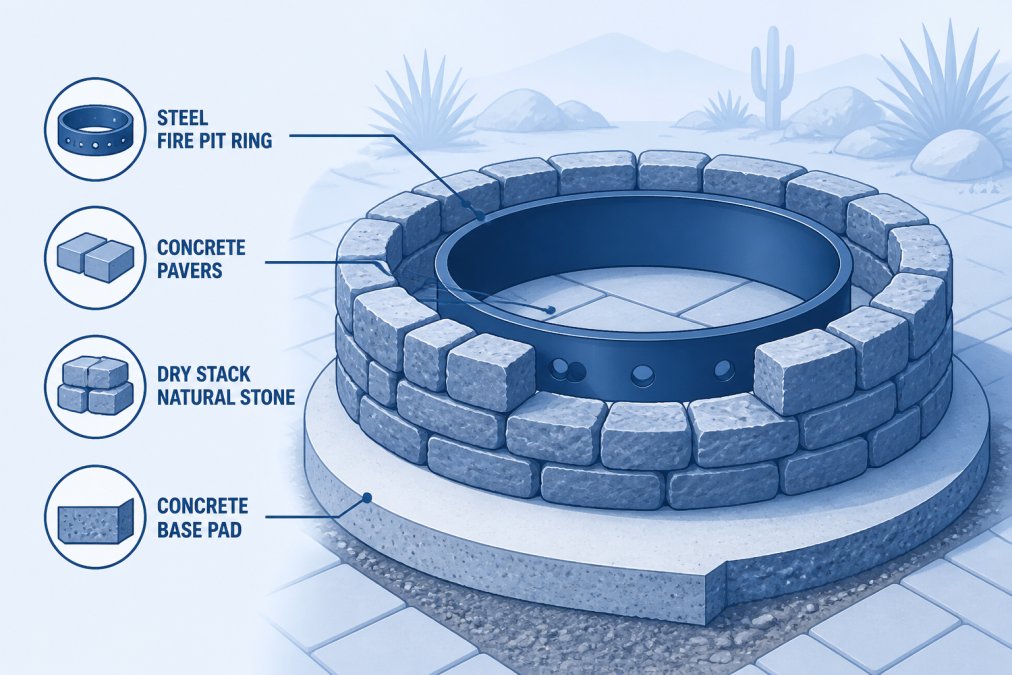
For built-in outdoor fireplaces, the foundation must be engineered to support the weight of the structure, often several thousand pounds. This typically requires a poured concrete footing below the frost line.
| Material | Best For | Heat Rating | Code Compliant |
|---|---|---|---|
| Concrete block | Fire pit walls, fireplace surround | High | Yes |
| Fire brick | Firebox interior lining | Very high (2,000°F+) | Yes |
| Natural stone | Decorative surround, hearth | Moderate to high | Yes (species-dependent) |
| Steel fire ring | Fire pit liner | High | Yes |
| River rock | Decorative only | Low (crack risk) | Not for firebox |
| Synthetic decking | Surrounding area | None | No |
Gas Line Installation and Shut-Off Valve Safety
Gas line installation for outdoor fire features is not a DIY project. In California, gas line work requires a licensed contractor, typically a plumbing contractor with a gas piping endorsement or a licensed general contractor coordinating with a licensed plumber.
A correctly installed gas system includes:
- Dedicated shut-off valve located within 6 feet of the appliance and accessible without tools
- Properly sized gas regulator matched to the BTU demand of the fire feature
- Pressure testing of all connections before first use
- Approved flexible connector if the fire feature allows for any movement
- Burial depth compliance for underground lines (typically 12-18 inches for metallic pipe in California)
- Leak detection at all joints using listed leak detection solution
For propane systems, tank storage location matters. The Riverside County Fire Department fire safety code requirements specify minimum distances for propane tank placement relative to structures and ignition sources. A 100-pound propane tank must be stored at least 10 feet from any structure.
Natural gas line connections require a permit and inspection by your local building department. The gas company will not reconnect service after a new installation without a passed inspection.
Climate, Insurance, and Liability: What Coachella Valley Homeowners Often Overlook
Most installation guides stop at materials and clearances. This section covers the two factors that create the most financial exposure: your local climate conditions and your insurance coverage.
How Desert Heat and Wind Affect Fire Feature Placement
The Coachella Valley presents specific challenges that don't appear in generic installation guides.
Wind: Santa Ana wind events can reach 60-80 mph. A fire feature meeting standard 10-foot clearance requirements can become hazardous in high-wind events. Position fire features on the leeward side of structures where possible, and orient the firebox opening away from prevailing wind direction.
Ambient temperature: Summer temperatures regularly exceed 110°F. This affects gas pressure in propane systems and accelerates wear on seals and connectors. Inspect gas connections more frequently in summer months.
Vegetation dryness: Coachella Valley landscaping dries out faster than in coastal climates. Treat the 10-foot clearance from vegetation as a minimum and clear additional buffer space in dry conditions.
Insurance Coverage and Homeowner Liability
Many homeowners assume their standard homeowner's policy automatically covers a new fire feature. It often does not without notification.
Adding a permanent outdoor fireplace or built-in fire pit is a material change to your property. Failing to notify your insurer can result in a coverage denial if a fire originates from the feature. The Insurance Information Institute guidance on home insurance and outdoor features recommends notifying your insurer before installation.
Key insurance considerations:
- Liability coverage: If a guest is injured near your fire feature, your homeowner's liability coverage applies only if the feature was disclosed and the installation was permitted
- Property coverage: Fire damage originating from an unpermitted structure may be excluded from coverage
- Premium impact: A permanent outdoor fireplace may increase your premium modestly; the cost is typically far less than the liability exposure of going uninsured
Document your installation with photos, permits, and inspection records.
Post-Installation Safety Inspection Checklist for Outdoor Fire Features
A post-installation inspection is the step most homeowners skip. It's also the step that catches problems before they become emergencies.
Use this checklist before the first use and annually thereafter:
Structural and foundation checks:
- Confirm no settling, cracking, or shifting in the foundation or firebox walls
- Verify all mortar joints are intact and no stones or blocks have shifted
- Check that the fire pit ring or firebox liner is seated correctly and shows no deformation
Clearance verification:
- Measure clearance to all structures; confirm nothing new has reduced buffer zones
- Remove any combustible materials within the clearance zone
- Verify overhead clearance is free of new vegetation growth
Gas system checks (gas features only):
- Perform a leak test on all gas connections using listed leak detection solution
- Confirm shut-off valve operates freely and closes completely
- Inspect flexible connector for kinks, corrosion, or wear
- Verify regulator is functioning and check for consistent flame height at startup
Wood-burning feature checks:
- Inspect spark arrestor for damage or clogging
- Clear ash and debris from firebox
- Confirm fire screen or spark guard is present and functional
Installing outdoor fire features safely requires treating the project as a compliance and safety exercise first, and a design project second. The permit process, clearance requirements, material specifications, and gas line standards exist because improperly installed fire features cause real harm.
The allvalley team has helped Coachella Valley and Riverside County homeowners navigate this process for over 26 years. Our professional installation services handle the technical details, from site assessment and permitting guidance to proper gas line coordination and final inspection prep. If you're planning a fire feature installation and want to get it done right the first time, CALL US @ 760-342-5277 and let's talk through your project.
Frequently Asked Questions
How far should a fire pit be from my house according to local codes?
Most local building codes in California, including Riverside County, require a minimum 10-foot clearance between a fire pit and any structure, fence, or combustible surface. Some jurisdictions set that buffer zone at 15 feet for wood-burning units. Always verify with your local building department before installation, since landscaping regulations and HOA rules can impose stricter distances than the base code requires.
Do I need a permit to install an outdoor fire feature?
In most Riverside County and Coachella Valley cities, yes. Outdoor fireplace permit requirements typically apply to any permanent structure, gas line connection, or fire feature that attaches to a structure. Portable propane fire pits sometimes fall outside permit rules, but a natural gas line installation always requires a permit and inspection. Check with your city's building department before breaking ground to avoid fines or forced removal.
What are common safety issues with outdoor fire features?
The most frequent hazards include insufficient clearance from combustible surfaces, missing or faulty shut-off valves on gas lines, improper non-combustible base materials, and no spark arrestor on wood-burning units. In desert climates like the Coachella Valley, high winds dramatically increase ember travel risk. A professional installation and post-installation safety inspection catches these issues before they become a fire hazard or an insurance liability.
Does an outdoor fireplace need a foundation?
Yes. Any permanent outdoor fireplace requires a fire-safe foundation, typically a reinforced concrete pad or compacted non-combustible base thick enough to handle the unit's weight and heat dissipation. Building codes require structural integrity sufficient to prevent settling or shifting that could crack gas fittings. Skipping a proper foundation is one of the most common DIY installation mistakes and can void your homeowner's insurance coverage.
This article was written using GrandRanker