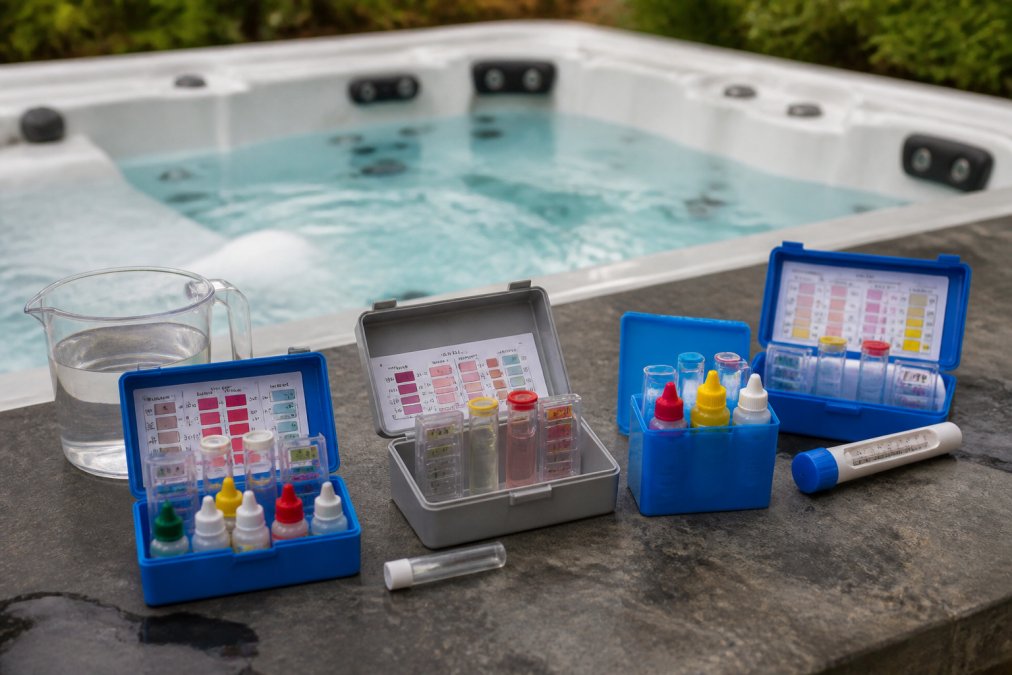
 listicle
5 Best Hot Tub Water Testing Kits for 2026
Table of Contents
- Quick Comparison: 5 Best Hot Tub Water Testing Kits
- 1. Poolmaster 22260 5-Way Test Kit: Best for Titration Accuracy
- 2. JNW Direct 6-in-1 Test Strips: Best for Frequent, Affordable Testing
- 3. AquaChek Digital Test Strip Reader: Best for Eliminating Color-Matching Guesswork
- 4. U.S. Pool Supply Premium 5-Way Test Kit: Best Professional-Grade Liquid Kit
- 5. 4-in-1 TDS Digital Water Tester: Best for Monitoring Total Dissolved Solids
- How to Balance Hot Tub Chemicals After Testing
- Hot Tub Water Testing Frequency: How Often Is Enough?
- Frequently Asked Questions
Last Updated: September 20, 2026
Quick Comparison: 5 Best Hot Tub Water Testing Kits
Finding the 5 best hot tub water testing kits comes down to one question: how much accuracy do you actually need? Test strips suit weekly checks, while liquid titration kits deliver the precision required when your spa water chemistry drifts. This guide from allvalley, which has spent over 26 years helping homeowners build low-maintenance backyard retreats, breaks down five proven options.
Here is the short version before the details:
| Kit | Method | Parameters Tested | Best For |
|---|---|---|---|
| Poolmaster 22260 5-Way | Liquid titration | pH, chlorine, bromine, alkalinity, acid demand | Precision testing |
| JNW Direct 6-in-1 Strips | Colorimetric strips | 6 parameters incl. cyanuric acid | Frequent, low-cost checks |
| AquaChek Digital Reader | Digital strip reader | Free chlorine, bromine, pH, alkalinity | Eliminating color guesswork |
| U.S. Pool Supply 5-Way | Liquid titration | pH, chlorine, bromine, alkalinity, acid demand | Standard maintenance |
| 4-in-1 TDS Tester | Digital meter | TDS, conductivity, temperature | Mineral buildup tracking |
1. Poolmaster 22260 5-Way Test Kit: Best for Titration Accuracy
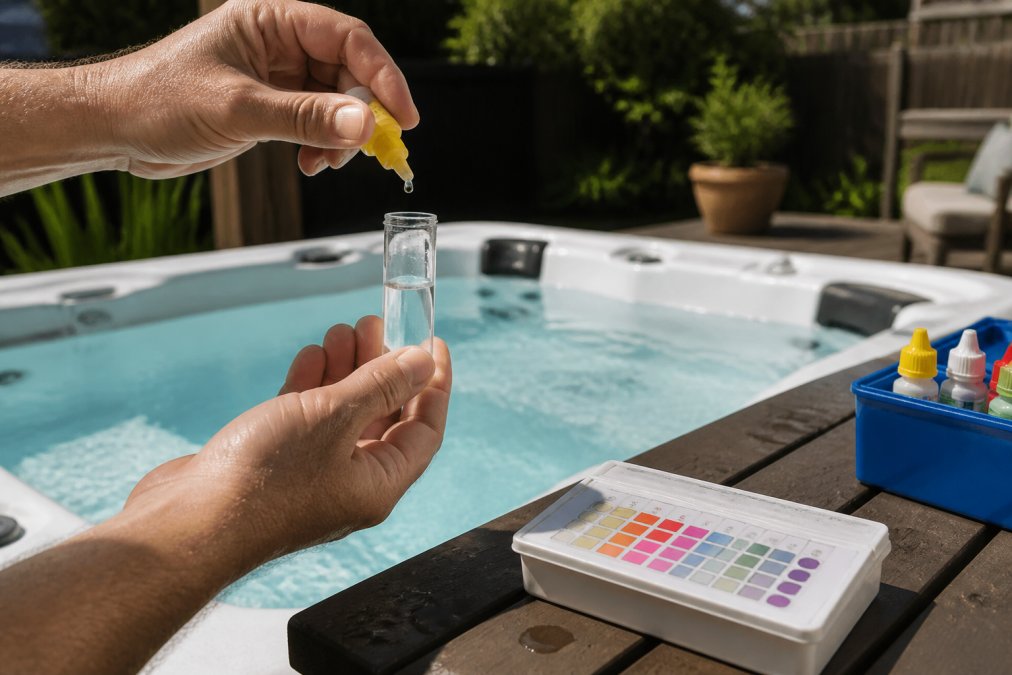
Liquid titration remains the gold standard for accuracy, and the Poolmaster 22260 delivers it for around $19.99. You count reagent drops until the sample changes color, which removes the guesswork that plagues strip-based testing.
Pros:
- Highly reliable, repeatable results
- Comprehensive 5-way testing in one case
- Durable storage case keeps reagents organized
Cons:
- More manual effort than strips
- Reagents expire and need replacing
2. JNW Direct 6-in-1 Test Strips: Best for Frequent, Affordable Testing
At $15.97 for 100 strips, the JNW Direct kit costs pennies per test, making it the practical choice for checking water every few days. Each strip reads six parameters: total hardness, total chlorine, free chlorine, pH, total alkalinity, and cyanuric acid.
Pros:
- Very low cost per test
- Results in seconds
- Broad six-parameter panel
Cons:
- Color matching is subjective
- Slight reading variations between users
3. AquaChek Digital Test Strip Reader: Best for Eliminating Color-Matching Guesswork
If you have ever squinted at a strip wondering whether that shade is "ideal" or "high," the AquaChek Digital Reader solves it. The device scans compatible strips and displays numeric results for free chlorine, bromine, pH, and total alkalinity.
Pros:
- Clear numeric output, no interpretation
- Simple interface
- Reduces reading ambiguity
Cons:
- Requires ongoing purchase of specific compatible strips
- Higher upfront cost
4. U.S. Pool Supply Premium 5-Way Test Kit: Best Professional-Grade Liquid Kit
The U.S. Pool Supply kit mirrors the Poolmaster's approach at the same $19.99 price point, testing pH, chlorine, bromine, alkalinity, and acid demand through liquid reagents. Instructions are printed clearly, which helps first-time spa owners learn the titration process properly. Mastering these manual measurements provides a reliable foundation for maintaining pool chemistry throughout the changing seasons.
Pros:
- Professional-grade accuracy
- All standard reagents included
- Compact for storage near the spa
Cons:
- Reagents have a shelf life
- Drop counting takes practice
5. 4-in-1 TDS Digital Water Tester: Best for Monitoring Total Dissolved Solids
Total dissolved solids (TDS) measures everything dissolved in your water: minerals, salts, metals, and leftover chemicals. This $12.99 digital meter reads TDS, electrical conductivity, and temperature with automatic temperature compensation.
Pros:
- Objective numeric data
- Very simple operation
Cons:
- No chlorine or bromine measurement
- Tells you when to drain, not how to balance
How to Balance Hot Tub Chemicals After Testing
Balancing hot tub chemicals follows a fixed order, because each parameter affects the next. Test first, then adjust in this sequence:
- Total alkalinity (target 80-120 ppm): this buffers pH and prevents bounce
- pH (target 7.4-7.6): adjust after alkalinity settles
- Sanitizer (chlorine 3-5 ppm or bromine 4-6 ppm): add after pH is stable
- Calcium hardness (target 150-250 ppm): prevents scale and corrosion
- Shock treatment: oxidizes built-up waste weekly
Why the Order Matters (The Mechanism)
Alkalinity is a buffer: it resists pH change by neutralizing added acid or base. If you adjust pH before alkalinity is in range, the unbuffered water swings right back the moment a bather enters or you add sanitizer. That is why every titration kit includes an acid demand test, it tells you how much pH decreaser the current alkalinity will absorb before the reading holds.
Dosing Math You Can Actually Use
Most liquid kits print a dosing table on the reagent bottle, but the numbers assume a specific spa volume. Know yours before you pour:
- Alkalinity increaser (sodium bicarbonate): roughly 1.5 oz per 500 gallons raises TA by about 10 ppm
- pH decreaser (sodium bisulfate): roughly 0.5 oz per 500 gallons lowers pH by about 0.2
- Calcium hardness increaser: roughly 1 oz per 500 gallons raises CH by about 10 ppm
What Each Parameter Actually Does
| Parameter | Target | What It Controls |
|---|---|---|
| Total alkalinity | 80-120 ppm | pH stability; prevents bounce |
| pH | 7.4-7.6 | Sanitizer efficiency; bather comfort |
| Free chlorine | 3-5 ppm | Kills bacteria; oxidizes waste |
| Bromine | 4-6 ppm | Same role as chlorine, stabler at high heat |
| Calcium hardness | 150-250 ppm | Prevents scale (high) and corrosion (low) |
| Cyanuric acid | 30-50 ppm | Shields chlorine from UV breakdown |
Reading the Result, Not Just the Number
A test result is a snapshot, not a diagnosis. If pH reads 7.8 but alkalinity is 60 ppm, the pH number is unreliable, fix alkalinity first and re-read. If free chlorine reads 0 but total chlorine reads 3, you have chloramines (combined chlorine), and the fix is shock, not more sanitizer. Titration kits that separate free and total chlorine exist for exactly this reason; strips that report only "total chlorine" hide the distinction.
Hot Tub Water Testing Frequency: How Often Is Enough?
Hot tub water testing frequency depends on use. Test sanitizer and pH daily or before every soak, since bather load and heat burn through chlorine quickly. Run a full panel weekly, and check total dissolved solids monthly.
The Bather-Load Rule Most Guides Skip
Chlorine demand scales with people, not with the calendar. A reasonable working estimate: each bather-hour in a hot spa consumes roughly 2-3 ppm of free chlorine. Two adults soaking 30 minutes is about 2-3 ppm gone. Four adults for an hour is 8-12 ppm gone, more than a typical 3-5 ppm residual can absorb. That is why "test daily" is too vague: test after a heavy soak, not just on a schedule.
Seasonal and Event-Based Triggers
Beyond the daily/weekly/monthly baseline, test after any of these:
- New fill water, test before adding anything; municipal water varies widely in alkalinity and CH
- Heavy rain, dilution drops sanitizer and can shift pH; runoff adds organics
- Extended non-use, a spa sitting idle for a week still loses chlorine to sunlight and heat
- After shocking, confirm free chlorine has dropped back to 3-5 ppm before soaking
- After adding a new chemical, verify it did what the label promised
Calibration and Reagent Cadence (The Part Competitors Ignore)
Digital testers and liquid kits have their own maintenance clocks that most frequency guides never mention:
- Digital meters (TDS, pH pens): calibrate monthly with fresh calibration solution, or before any reading you will act on. A pH pen that has drifted 0.3 reads "fine" while your water is actually at 7.9. Calibration solution costs roughly $10-15 per bottle and expires, check the date.
- pH electrode replacement: most consumer pens need a new electrode every 12-18 months, often costing as much as the pen itself. Factor that into the total cost of ownership before you buy digital.
- Liquid reagents: replace every 12 months, or sooner if stored warm. A reagent that has gone off gives a color change at the wrong drop count, which is worse than no test at all because it looks authoritative.
- Test strips: the bottle's expiration date is real. Strips exposed to humidity in a spa cabinet read high on alkalinity and low on sanitizer.
Disposing of Expired Reagents Safely
Expired liquid reagents should not go down the drain or into the trash in bulk. Many contain acids, bases, or metal indicators. Check your municipal household hazardous waste program, most accept pool and spa chemicals on designated drop-off days. Never mix reagents from different kits to "use them up," and never pour them into the spa to dispose of them.
Daily sanitizer checks plus a weekly full panel catch nearly every imbalance before it turns into cloudy water or a drained spa, but only if your reagents and meters are in calibration. A trustworthy test on the wrong schedule beats a sloppy test on the right one.
Frequently Asked Questions
What is the best way to check the water quality in my hot tub?
The most reliable method is a liquid titration kit, which uses reagent drops to measure pH, alkalinity, and sanitizer levels with high precision. Test strips offer speed and convenience for routine checks, while a digital reader removes the subjectivity of color matching. For best results, test with a liquid kit weekly and use strips for quick daily checks, especially after heavy use or rainfall.
Are digital hot tub testers better than strips?
Digital readers like the AquaChek Digital Test Strip Reader eliminate the guesswork of color matching, which is the biggest weakness of traditional strips. They provide numeric results that are easier to interpret. However, they still require compatible strips and do not measure every parameter a liquid kit can. If you struggle with color interpretation, a digital reader is a worthwhile upgrade over standard strips.
How often should you test hot tub water?
Test sanitizer and pH levels daily or every other day, depending on use. Alkalinity and calcium hardness should be checked weekly. After heavy bather loads, rain, or adding fresh water, test immediately. Hot tub water testing frequency increases during summer months or when the spa is used by multiple people. Keeping a log helps you spot trends before they become problems.
What chemical levels should I look for in a hot tub test kit?
Target pH between 7.4 and 7.6, total alkalinity between 80 and 120 parts per million, and free chlorine between 1 and 3 ppm or bromine between 3 and 5 ppm. Calcium hardness should stay between 150 and 250 ppm, and cyanuric acid below 50 ppm if used. These ranges keep water clear, comfortable, and safe for bathers.