 how-to
Signs Your Hot Tub Filter Needs Replacing: 7 Clear Warnings
Table of Contents
- 7 Warning Signs Your Hot Tub Filter Needs Replacing
- How to Inspect Your Filter for Damage and Wear
- Hot Tub Filter Maintenance Schedule: Rinsing, Soaking, and Deep Cleaning
- How to Clean Hot Tub Filter Cartridges Without Damaging Them
- Hot Tub Filter Replacement Frequency: When to Clean vs. When to Replace
- How a Clogged Filter Affects Heater Performance and Circulation
- Filter Sizing, Compatibility, and Disposal: What Most Owners Miss
- Conclusion: Keep Your Hot Tub Filter Working Longer
- Frequently Asked Questions
Last Updated: October 3, 2026
7 Warning Signs Your Hot Tub Filter Needs Replacing
A hot tub filter is the cartridge that traps dirt, oil, and debris before water cycles back through the jets. When it fails, every other part of the system works harder and water quality drops fast.
Filters rarely fail all at once.
Below are the seven warnings to watch for, plus how to inspect, clean, and replace your filter.
Cloudy Water and Weak Water Flow
Cloudy water is the most common early warning. If it looks milky or dull even after you balance the chemicals, the filter is likely packed with debris and can no longer catch fine particles.
Weak flow is the twin symptom. Clogged pleats restrict water, so jets feel soft and the circulation pump works harder to move the same amount of water.
Watch for:
- Water that stays cloudy after shocking
- Jets that feel weaker than they used to
- Visible debris accumulation floating after a soak
Musty Odor and Rising Pressure Gauge Readings
A musty odor points to trapped organic matter. Oils, sweat, and lotion sit in the filter media and bacteria feed on them, the smell comes from the filter, not the water alone.
On systems with a pressure gauge, rising pressure tells the same story: as the cartridge clogs, resistance builds and the gauge climbs. If pressure keeps rising after a rinse, the filter is spent.
How to Inspect Your Filter for Damage and Wear
Inspection takes about five minutes. Pull the cartridge, rinse it, then work through the checks below in order.
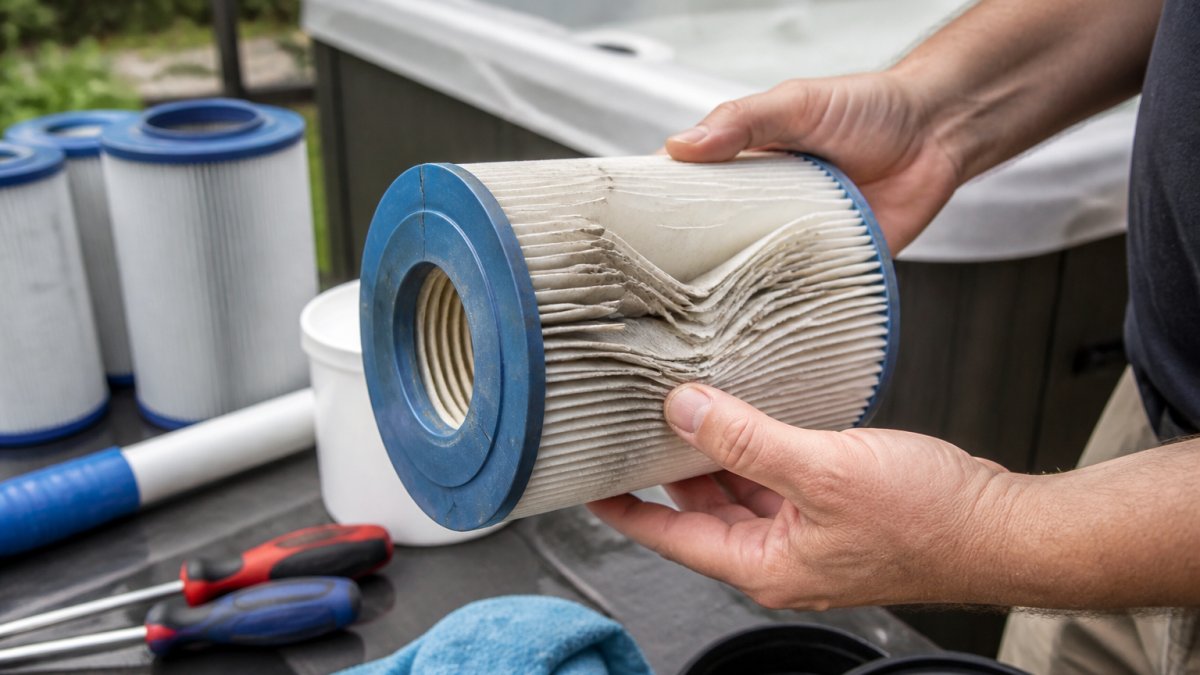
Step 1: Read the pleats like a map
Hold the cartridge up to daylight and look down the pleats. Healthy pleats stand in even, parallel folds with visible gaps. Look for:
- Crushed or matted folds, pleats that have collapsed flat against each other and no longer spring apart
- Frayed or fuzzy edges, the fabric is shedding fibers, which means the media is breaking down and releasing debris back into the water
- Gray or brown discoloration that survives a rinse, staining that will not lift after a soak means oils and minerals have bonded to the media
A filter with frayed edges or bald patches is done. No amount of cleaning restores fabric that has physically worn away.
Step 2: Check the end caps and core
End caps hide most silent failures. Run your thumb around the top and bottom rims and check for:
- Hairline cracks in the plastic, especially where the cap meets the pleated media
- Loose or separated caps, if you can wiggle the cap independently of the media, water is bypassing the filter
- A cracked or bowed center core, the perforated tube should be straight and rigid; a warped core distorts the pleats around it
A cracked end cap is a replacement trigger even if the pleats look fine, because unfiltered water flows straight past the media and back into the spa.
Step 3: The squeeze test
Squeeze a section of pleats gently, then let go. A healthy cartridge springs back; a spent one stays compressed, feels stiff or brittle, or crunches. If pleats stay flattened, the media has lost its structure and cleaning will not restore it.
Step 4: Look for the waterline band
On most spas, the cartridge's top portion meets the water line, where body oils, sunscreen, and lotion concentrate. A greasy ring is normal between cleanings, but if it survives a full soak and rinse, the oils have saturated the media and are feeding the bacteria behind that musty smell.
Step 5: Compare against a new cartridge
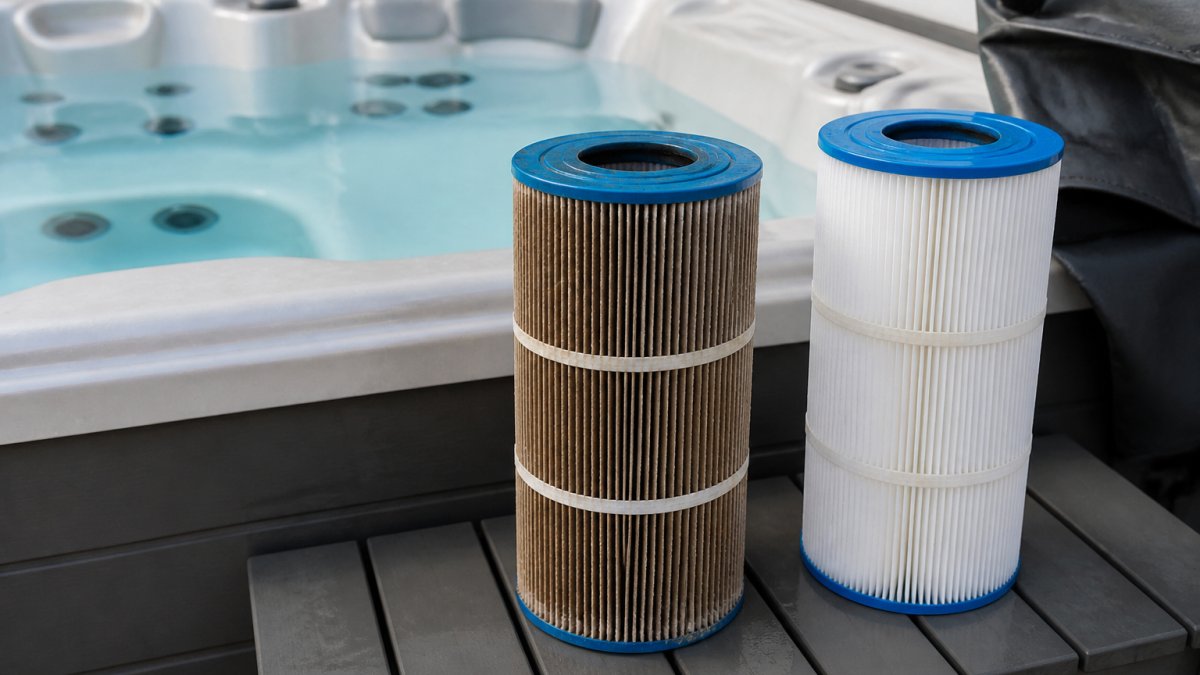
If you keep a spare, set the old cartridge beside it. Side-by-side comparison quickly reveals what your eye has normalized: shorter pleats, duller color, softer feel, a swollen body. Most owners are surprised by how much the media has compressed.
Quick verdict table
| What you see | What it means | Action |
|---|---|---|
| Even pleats, springs back, no cracks | Healthy | Rinse and reinstall |
| Gray staining that rinses off | Normal buildup | Soak and deep clean |
| Matted pleats that stay flat | Media collapsed | Replace |
| Frayed edges or bald spots | Fabric worn through | Replace |
| Cracked or loose end cap | Bypass failure | Replace |
| Warped center core | Structural damage | Replace |
Tears, cracks, or permanent matting mean replacement is the only option.
Hot Tub Filter Maintenance Schedule: Rinsing, Soaking, and Deep Cleaning
A consistent hot tub filter maintenance schedule separates a filter that lasts years from one that dies in months. The routine has three levels.
| Task | Frequency | Time Needed | What It Does |
|---|---|---|---|
| Rinse | Every 1-2 weeks | 5-10 minutes | Clears loose debris |
| Soak | Every 1-2 months | 2-4 hours | Breaks down oils |
| Deep clean | Every 3-4 months | Overnight | Restores full flow |
Rinsing with a filter flosser or hose nozzle clears surface debris before it works into the pleats. Soaking in a soaking solution dissolves oils and lotion water alone cannot remove. Deep cleaning handles sediment buildup deep in the media.
How to Clean Hot Tub Filter Cartridges Without Damaging Them
Most filter damage comes from cleaning, not use. A few habits keep the cartridge intact.
- Turn off the spa and remove the cartridge from the filter housing.
- Rinse top to bottom with a hose, working between each pleat.
- Use a filter flosser to reach deep folds without bending them.
- Soak in a filter cleaner for the time on the label.
- Rinse again until the water runs clear.
- Let it air dry completely before reinstalling.
Never use a pressure washer on high settings, and never scrub with a stiff brush. Both crush the filter pleats and open gaps that let debris through.
Hot Tub Filter Replacement Frequency: When to Clean vs. When to Replace
Hot tub filter replacement frequency depends on use, not the calendar. Most cartridges last one to three years, but heavy use shortens that window, the difference between three years and eight months is almost always bather load, not brand.
Estimate your filter's real lifespan
Instead of a generic "every three months" rule, estimate weekly bather-hours: multiply the number of people who soak by average soak length in hours, then by soaks per week.
- 1-2 bather-hours per week (one or two people, a couple of short soaks): expect 2-3 years from a quality cartridge
- 3-6 bather-hours per week (a family soaking most evenings): expect 12-18 months
- 7-14 bather-hours per week (daily use, kids, guests): expect 8-12 months
- 15+ bather-hours per week (rental, party spa, heavy entertaining): expect 6-9 months, and keep a spare on the shelf
Two factors push you toward the shorter end of any range: high sanitizer levels that degrade media faster, and heavy sunscreen or lotion use that loads pleats with oils.
The clean-versus-replace decision framework
Ask three questions in order. Stop at the first "yes", that answer decides the outcome.
- Does the cartridge pass the physical inspection? If the pleats are matted, frayed, or the end caps are cracked, replace. Cleaning cannot restore structure.
- Does the filter still perform after a deep clean? Rinse, soak, dry, reinstall, then run the spa for a full cycle. If flow is still weak or pressure still climbs, the media is saturated and the cartridge is spent.
- Has it been more than 12 months of regular use? Even a filter that looks acceptable is usually past its best filtration by the one-year mark under average use. Finer particles start slipping through long before the cartridge looks obviously bad.
If you are unsure at any step, replace. A new cartridge costs far less than the pump, heater, or chemistry problems that a failing filter causes.
The cost trade-off
A replacement cartridge is a small, predictable expense. Running a clogged filter instead means longer heater run times, higher energy use, extra sanitizer, and eventually a circulation pump repair or replacement. Replacing on schedule is the cheaper path over any two-year window.
Keep a rotation
Many owners get more total life from two cartridges than one. Keep a clean, dry spare, swap it in at each deep clean, and let the used one soak and dry fully before it goes back in. Your spa never runs on a wet cartridge, and you always have a known-good filter to test against when flow feels off.
How a Clogged Filter Affects Heater Performance and Circulation
A clogged filter strains the whole system.
The circulation pump suffers too, pushing against resistance that wears it down over time. On some systems, low flow can trigger a GFI trip as equipment overheats or draws uneven power.
Poor circulation also weakens spa water chemistry. Without steady flow, sanitizer cannot spread evenly, and combined chlorine builds up.
Filter Sizing, Compatibility, and Disposal: What Most Owners Miss
Buying the wrong cartridge is the most common mistake. A filter that is slightly too small lets water bypass the media entirely, all the cost, none of the filtration.
Match these specs before you buy:
- Top and bottom end caps: open, closed, or threaded
For disposal, check with your local waste service. Many municipal programs accept spent cartridges with bulky plastics, but rules vary. Rinsing before disposal keeps oils out of the waste stream and eases recycling where offered.
Conclusion: Keep Your Hot Tub Filter Working Longer
A failing filter shows up in your water long before your wallet. Cloudy water, weak jets, rising pressure, and that musty smell are early warnings you can act on.
At allvalley, we have spent 26 years helping homeowners build backyards that are ready for fun, not constant upkeep. Every hot tub we sell comes with a free starter kit and chemicals, so you start with the right supplies from day one.
Call us at 760-342-5277 to find the right hot tub and filter setup for your backyard.
Frequently Asked Questions
What is the lifespan of a hot tub filter?
A standard cartridge filter typically lasts one to three years, depending on use. Heavy bather load, frequent use, and skipped rinsing shorten that window. Filters that run in a hot tub used daily often need replacing closer to the one-year mark, while a lightly used spa filter can stretch toward three years. Watch for crushed pleats, torn end caps, or persistent odor after cleaning as signs your hot tub filter needs replacing.
How often should you change a filter on a hot tub?
Most manufacturers recommend replacing the cartridge every 12 to 24 months, but replacement frequency depends on how often you use the spa and how well you maintain the filter. Rinse the cartridge every one to two weeks, soak it in a cleaning solution monthly, and replace it when water flow drops or the pleats stay matted after cleaning. If your hot tub runs daily with multiple users, plan on a yearly swap.
Can a dirty filter cause hot tub heating issues?
Yes. A clogged cartridge restricts water flow through the heater and circulation pump, which can trigger a flow error or slow heating. When the pressure gauge climbs and the heater struggles, the filter is often the first thing to check. Cleaning or replacing the cartridge usually restores normal heating efficiency, but persistent problems may point to a failing pump or a GFI trip that needs professional attention.
How do I know if my hot tub is filtering properly?
Clear water, steady flow from the jets, and a pressure gauge reading in the normal range are the clearest signs your hot tub is filtering properly. Cloudy water, a musty odor, or rising sanitizer demand suggest the filter is not doing its job. Check the cartridge for debris accumulation and matted pleats. If rinsing does not restore flow, it is time to deep clean or replace the filter.