 listicle
Affordable Alternatives to Stone Patio Pavers for 2026
Table of Contents
- Quick Comparison: Affordable Alternatives to Stone Patio Pavers
- DIY Patio Ideas on a Budget That Actually Last
- Cost Comparison of Patio Materials: What You'll Pay Per Square Foot
- Decomposed Granite Patio Pros and Cons
- Gravel, Concrete, and Resin: Three Low-Cost Patio Surfaces
- Drainage, Permeability, and Weight-Bearing: What Most Guides Skip
- Climate-Specific Suitability for Desert Backyards
- Conclusion
- Frequently Asked Questions
Last Updated: September 25, 2026
Quick Comparison: Affordable Alternatives to Stone Patio Pavers
Stone patio pavers look great in photos. They also run $15 to $30 per square foot installed in many markets, which prices out plenty of backyards. This guide from allvalley covers the affordable alternatives to stone patio pavers that hold up to real use, not just one season of good intentions.
Below, we'll break down six options by cost, drainage, durability, and climate fit, so you can pick a surface that survives foot traffic, monsoon runoff, and 115-degree summers. The EPA's guidance on permeable surfaces and stormwater runoff explains why drainage matters as much as looks.
| Option | Cost per Sq Ft | Permeability | Best For |
|---|---|---|---|
| Crushed gravel | $1-$3 | High | Fast, budget-friendly patios |
| Recycled brick | $3-$8 | Moderate | Vintage, modular designs |
| Poured concrete | $4-$15 | Low | Heavy furniture, low upkeep |
| Porcelain tile | $5-$12 | Low | High-end indoor-outdoor flow |
| Resin bound gravel | $10-$20 | High | Smooth, modern surfaces |
| Decomposed granite | $2-$5 | High | Desert and dry climates |
DIY Patio Ideas on a Budget That Actually Last
The cheapest patio is the one you install once. A common mistake is skipping base preparation to save a weekend, then watching the surface shift within a year.
For DIY patio ideas on a budget, start with loose-fill surfaces like gravel or decomposed granite. Both need a compacted sub-base, landscape fabric to block weeds, and edging to hold the material in place. Setup typically takes a weekend for a small area.
- Crushed gravel: rake-and-go, but top it off every couple of years
- Decomposed granite: compacts firm, ideal for desert yards
- Recycled brick: modular and repairable, but labor-heavy to lay
- Pea stone: smooth underfoot, though it migrates into grass
Cost Comparison of Patio Materials: What You'll Pay Per Square Foot
Material cost is only half the story. A cost comparison of patio materials has to include base prep, edging, and labor, or the numbers mislead you. The table below separates those line items so you can see where the money actually goes.
| Material | Material Cost / Sq Ft | Base + Edging / Sq Ft | DIY Labor | Pro Install / Sq Ft | Lifespan |
|---|---|---|---|---|---|
| Crushed gravel | $1-$3 | $1-$2 | Low | $4-$7 | 5-10 years with topping off |
| Decomposed granite | $2-$5 | $1-$2 | Low | $5-$9 | 5-10 years |
| Recycled brick | $3-$8 | $2-$4 | High | $10-$18 | 20+ years |
| Poured concrete | $4-$8 | $1-$3 | Moderate | $8-$15 | 25+ years |
| Porcelain tile | $5-$12 | $3-$6 | High | $14-$25 | 20+ years |
| Resin bound gravel | $10-$20 | $2-$4 | Moderate | $16-$28 | 10-15 years |
Three cost mechanics drive the spread:
- Unit count. Poured concrete is priced by the cubic yard of mix plus forming labor, so there are no individual units to place. Brick and porcelain are priced per piece, and the labor scales with joint count.
- Replenishment. Loose aggregate loses roughly a quarter-inch of depth per year under foot traffic, so budget a top-off every two to three years. That recurring cost is why gravel wins on day one but not always on year ten.
- Base prep. A compacted 4-inch sub-base with landscape fabric and edging runs $1-$2 per square foot in materials alone. Skipping it is the single most common reason a budget patio fails inside two years.
For a full breakdown of how these surfaces compare, the Portland Cement Association's guide to concrete surfaces covers slab performance in detail.
Decomposed Granite Patio Pros and Cons
Decomposed granite is crushed rock that compacts into a firm, natural-looking surface. It is one of the most climate-appropriate choices for dry, hot regions.
The pros are real: low cost, high permeability, and a soft, organic look that pairs well with desert planting. The cons matter too. DG needs recompaction over time, can be dusty in wind, and tracks indoors without a stabilizer or binder.
- Pros: budget-friendly, drains fast, blends with natural stone and gravel
- Cons: needs periodic raking, can migrate, less firm than concrete
Gravel, Concrete, and Resin: Three Low-Cost Patio Surfaces
Each of these three surfaces solves a different problem. Gravel is the cheapest and most permeable. Concrete is the most durable and level. Resin bound gravel sits between them, smooth and modern but pricier.
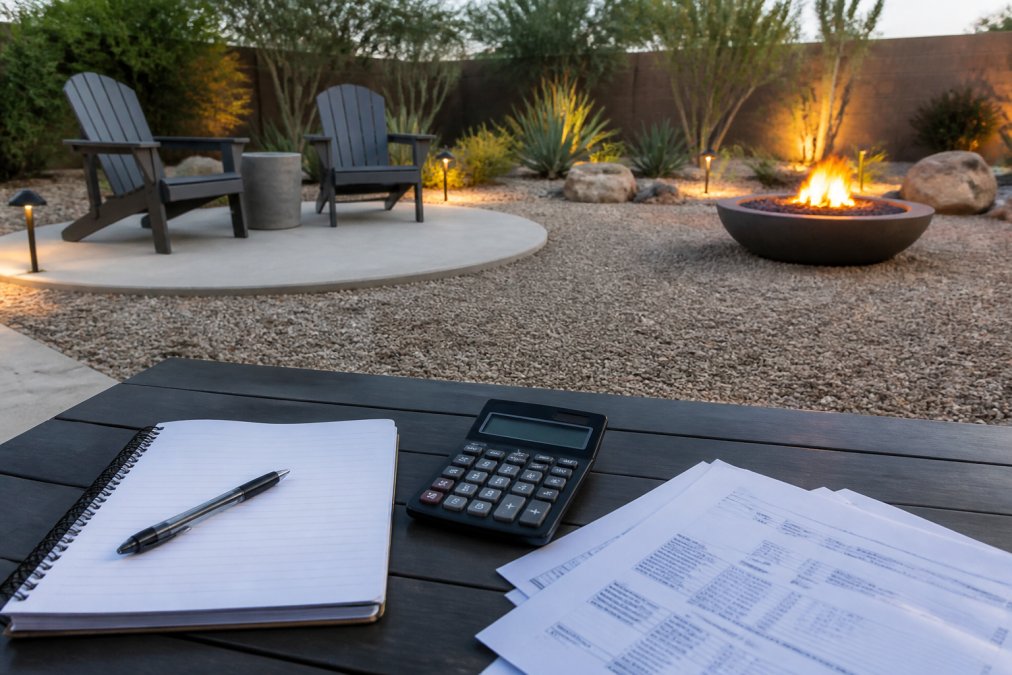
Crushed gravel handles foot traffic well and drains naturally, but it needs raking and occasional replenishment. Poured concrete gives you a seamless slab that supports heavy furniture and resists weeds between joints, though it can crack if the ground shifts. Resin bound gravel mixes aggregate with clear resin for a smooth, permeable finish with no loose stones to track inside.
A common mistake is choosing resin bound gravel for a large area without checking the sub-base. It needs a solid, level foundation or the surface fails early.
Drainage, Permeability, and Weight-Bearing: What Most Guides Skip
Most patio guides stop at looks. The three factors that decide whether a surface lasts are drainage, permeability, and weight-bearing capacity, and almost no budget-paver article explains how they interact.
Permeability is how fast water passes through a surface, measured in inches per hour. Loose aggregate and resin bound gravel drain fast enough to handle most residential storm intensities.
- Concrete and brick: carry heavy loads, grills, planters, hot tubs, without deformation.
- Porcelain tile on a proper base: handles furniture fine, but point loads on a hollow spot can crack a tile.
- Loose gravel and DG: fine for foot traffic and light chairs, but concentrated weight (a grill with small feet, a hot tub) sinks and shifts. Use a concrete pad under anything heavy.
- Resin bound gravel: more stable than loose aggregate but still not a structural slab.
| Factor | Best Performers | Weakest |
|---|---|---|
| Drainage | Gravel, DG, resin bound | Concrete, porcelain |
| Weight-bearing | Concrete, brick | Loose gravel |
| Low maintenance | Porcelain, concrete | Gravel, DG |
Climate-Specific Suitability for Desert Backyards
Heat and sun break down the wrong materials fast. In desert backyards, the surface has to resist UV fading, thermal expansion, and dry-season dust.
- Best for desert heat: porcelain tile, decomposed granite, gravel
- Watch for cracking: poured concrete without joints
- Watch for dust: unstabilized DG and fine gravel
Conclusion
Choosing a patio surface is a trade-off between upfront cost, maintenance, and how well it handles your climate. Get the base prep and drainage right, and even a budget-friendly gravel or decomposed granite patio can last for years.
Frequently Asked Questions
What is the cheapest hardscape option for a backyard patio?
Crushed gravel is typically the cheapest hardscape option, with material costs around $1 to $3 per square foot. It requires minimal base preparation and you can install it yourself with basic tools. However, gravel needs periodic raking and replenishment, so factor in ongoing maintenance. For a more permanent surface, poured concrete at $4 to $15 per square foot may offer better long-term value.
How much would a 20x20 paver patio cost compared to alternatives?
A 20x20 patio (400 square feet) using stone pavers often costs significantly more than alternatives. Crushed gravel would run roughly $400 to $1,200 in materials, while poured concrete could range from $1,600 to $6,000 installed. Resin bound gravel sits higher at $4,000 to $8,000. These figures are material and installation estimates only; get a local quote for your specific site conditions.
What are the pros and cons of using decomposed granite for a patio?
Decomposed granite (DG) offers a natural look, good permeability, and costs less than stone pavers. It compacts into a firm surface that handles foot traffic well. On the downside, DG can shift over time, requires periodic replenishment, and may produce dust. In windy desert areas, stabilizers or resin binders help reduce dust and erosion. It is not ideal for heavy furniture without a reinforced base.
Can you use wood mulch or wood chips as a patio surface?
Wood mulch or chips are not recommended for patios. They decompose quickly, attract insects, and become uneven under foot traffic. They also blow away in strong winds and need frequent replacement. For a budget-friendly organic look, consider gravel or decomposed granite instead. These materials last longer and require less upkeep while still providing a natural aesthetic.
How much money can you save by choosing alternative patio materials?
Savings vary by material and project size. Crushed gravel can cost 50% to 80% less than stone pavers per square foot. Poured concrete typically saves 20% to 50% over pavers, depending on finish and region. Recycled brick and porcelain tiles fall in the mid-range. Labor and base preparation are major cost factors, so DIY installation can increase your savings significantly.